



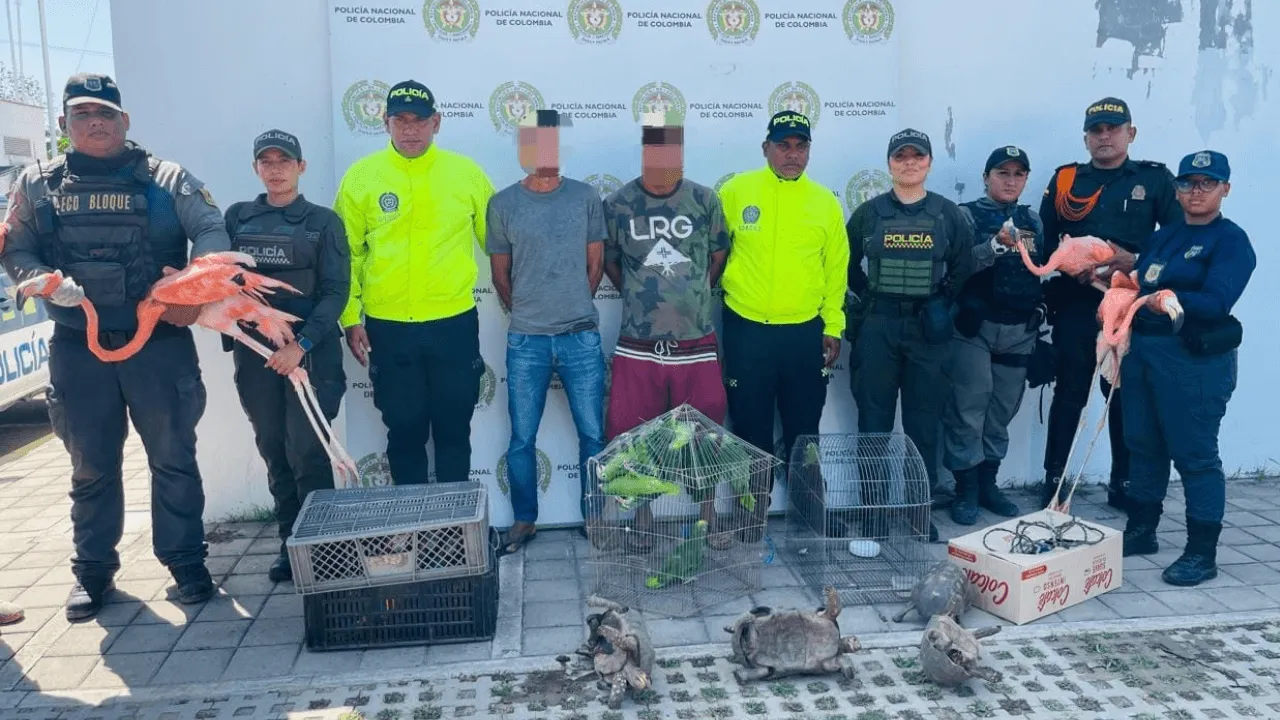
In the framework of the international operation Green Shield II (Wild Shield II), which brings together the police forces of Ecuador, Brazil, Peru, Bolivia, the United Arab Emirates, and Colombia, the National Police dismantled a network dedicated to the illegal trafficking of wildlife in the Caribbean region.
The offensive “Wild Shield” was led by the Directorate of Carabineros and Environmental Protection and allowed to strike a criminal group operating in Atlántico and Bolívar.
Raids and arrests
The Criminal Investigation Section carried out three search procedures in Barranquilla and Turbaco, where collection centers for the storage and illegal commercialization of species were operating.
- Three people were caught red-handed, accused of wildlife trafficking and illicit exploitation of natural resources.
- 109 specimens of wildlife were seized, illegally extracted from the Colombian Amazon and classified as endangered species.
- The commercial value of the animals exceeded 207 million pesos.
Impact on biodiversity
Brigadier General Carlos Germán Oviedo Lamprea, director of Carabineros and Environmental Protection, highlighted:
“Each rescued species represents another step in the defense of our country’s ecosystems.”
The operation affected the logistical and financial capacity of the criminal organization, weakening one of the most harmful illicit economies for conservation.
Consequences of wildlife trafficking
The illegal trafficking of species is considered the fourth most profitable illicit economy in the world, behind drugs, counterfeiting, and human trafficking. Its effects include:
- Environmental imbalances due to the extraction of animals from their habitats.
- Decrease in populations already threatened by deforestation and climate change.
- High mortality rates during transport due to stress, dehydration, and injuries.
- Clandestine markets that trade exotic pets and illegal by-products.
Institutional commitment
The National Police reaffirmed its commitment to the protection of wildlife and announced that it will continue to carry out operations to counteract activities that threaten natural resources. These actions aim to stop a criminal chain that begins with the extraction of animals and ends with their sale in illegal, often international, markets.
The rescue of more than 100 endangered species in Colombia represents a significant advance in the fight against wildlife trafficking.
The “Wild Shield” operation not only recovered valuable specimens for biodiversity but also weakened a criminal network that profited from the country’s natural heritage.
The defense of ecosystems requires active state presence and international cooperation to confront a crime that threatens the region’s biological wealth.



