



This Thursday, September 25th, the National Day of the Southern Right Whale is celebrated in Argentina. It is a chosen date to remember the day when an entire community came together to rescue “Garra”.
It is about an individual that had become entangled in the chains of a catamaran in the bay of Puerto Pirámides.
The Institute for the Conservation of Whales (ICB) recalled on this day their inspiring story that, over time, became a symbol of resilience and hope.
Garra, a historic rescue that united the community
The story that gave rise to this commemoration took place on September 25, 2002, when a young southern right whale got entangled in the mooring chains of a catamaran in the bay of Puerto Pirámides, in Península Valdés.
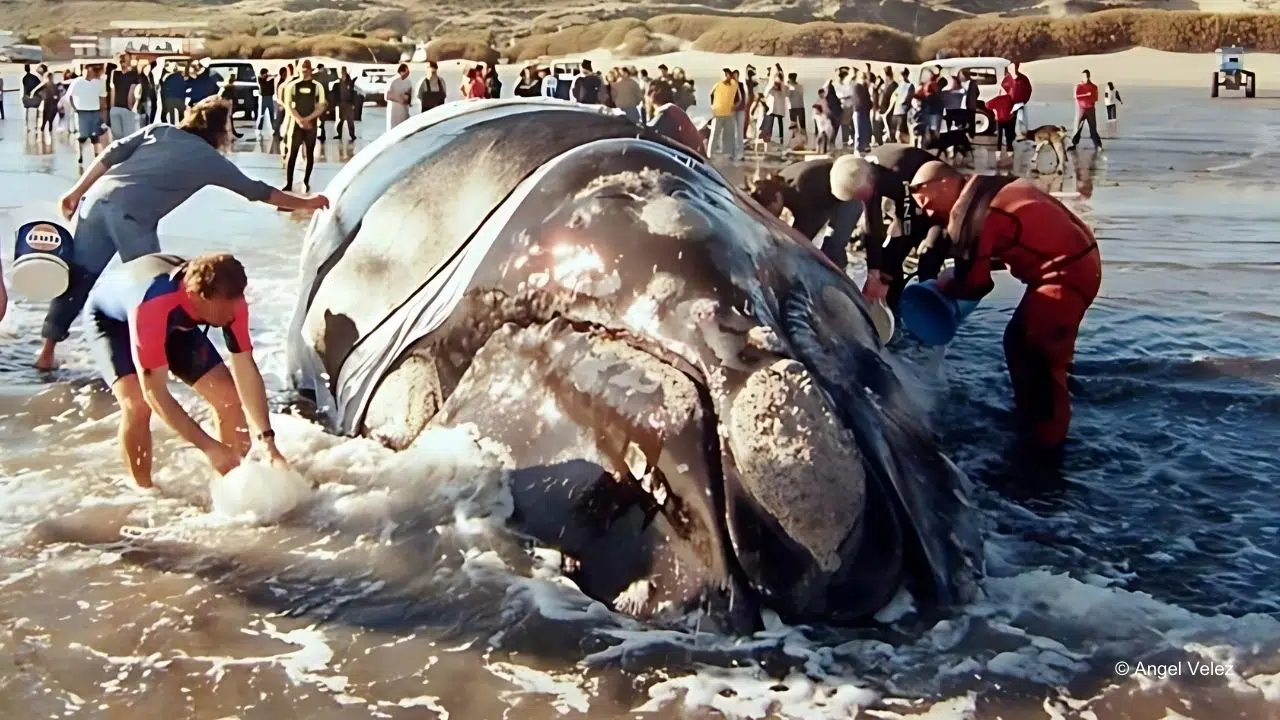 The historic rescue of ‘Garra’. (Photo: ICB).
Unable to access the chains underwater to cut them, divers and whale-watching guides made the unprecedented decision to implement another strategy: intentionally beaching the whale and waiting for the tide to recede to be able to cut the chains on the beach.
Once freed, with the participation of the whole community, the whale was kept cool and protected from the sun with damp blankets until the high tide covered it again.
At dusk, it regained buoyancy and returned to the sea, but it carried marks on its body as a result of human activities in its habitat. Thus, a historic rescue was achieved, the result of collective effort and the unity of the entire community.
History of its identification and legacy
“Through photo-identification, we were able to learn that Garra, the young whale at the center of this event, was born in 2001 and is the offspring of ‘Victoria’, a whale we have known since 1972, when the Southern Right Whale Research Program began,” stated the ICB.
It was Dr. Mariano Sironi, scientific director of the ICB, who first photographed Garra when it was a calf swimming alongside its mother in the Golfo San José. This record was particularly significant as it occurred a year before Garra got entangled in the bay of Puerto Pirámides.
The awaited confirmation of its survival
Garra, fortunately, survived despite the wounds and stress. In 2006, it was sighted in the bay of Puerto Pirámides and, more recently, it was identified from a random record obtained in 2020. In this case, it occurred during a survey of seabirds in the South Atlantic, near the Falkland Islands.
Biologist Florencia Vilches, a researcher at the ICB, recalled the discovery: “Thanks to this random record, we now know that at least until 2020, Garra was still roaming the waters of the South Atlantic,” she expressed.
“This finding fills us with joy and renews hope for a whale that is so special to the entire community of Puerto Pirámides,” she said.
The migratory movements of adult males, like Garra, are less known than those of adult females, which are found in the gulfs of Península Valdés between June and December to give birth, nurse, or wean their calves.
Garra has not been recorded in aerial photo-identification surveys in the last 20 years.
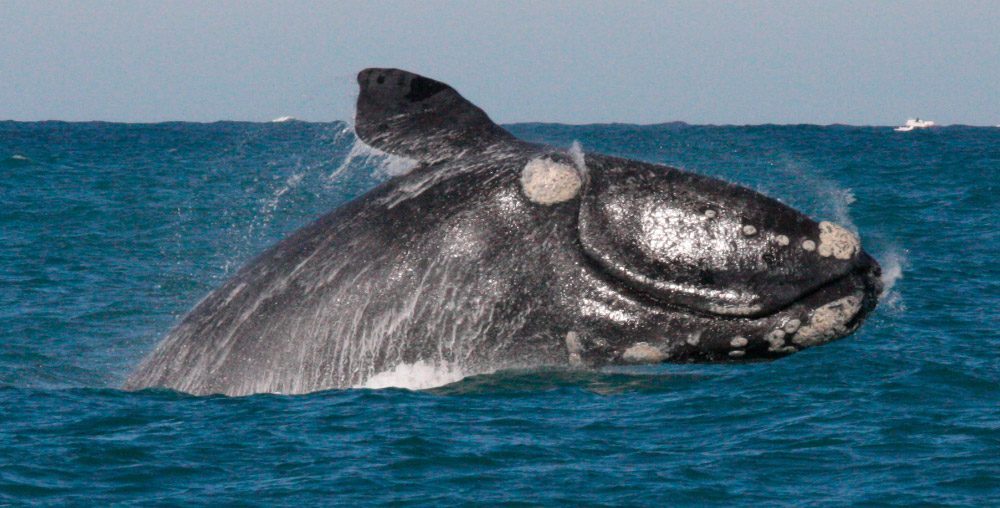 Conservation of the southern right whales.
Resilience, community, and habitat protection
Garra has been considered a resilient whale ever since because, despite suffering a serious incident and wounds that left marks on its body, it managed to survive and continue being part of the population.
Source: ICB



