



After a rehabilitation process, four howler monkeys were released in Corrientes. They are Bizcochito, Lisa, Nena, and Facena, specimens of the Alouatta caraya species.
The process was carried out by Aguará Center, after completing a recovery that highlights the risks of human contact with wildlife.
Four howler monkeys released after rehabilitation: the impact of human intervention
The stories of Nena and Facena exemplify how interaction with people and feeding outside their natural environment can alter the behavior of wild animals.
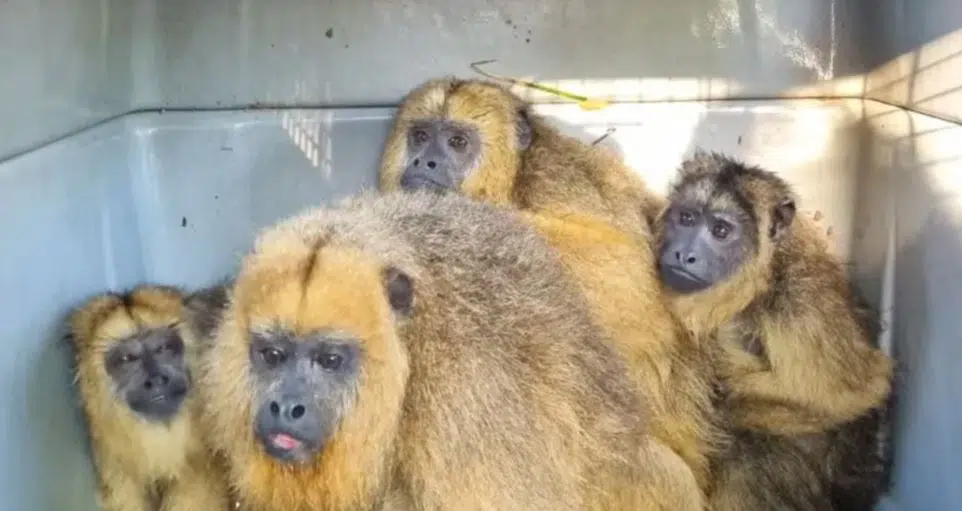 The howler monkeys released in Corrientes. (Photo: diario Época).
Both monkeys, although in different contexts, developed a dependency on humans that weakened their adaptation abilities and put them at risk.
Nena suffered a serious injury after being attacked while looking for food in a home. Facena, on the other hand, was separated from her family group after forming an unnatural bond with teachers and students, which affected her social behavior.
Comprehensive rehabilitation at the Aguará Center
The recovery process was carried out by technical teams and volunteers from the Aguará Center, who worked on the clinical and behavioral rehabilitation of the animals.
The tasks included detailed observations, veterinary treatments, nutritional adjustments, and specific actions to restore the natural distrust towards humans. Something essential for their reintegration into the wild.
Thanks to the joint work, Nena and Facena managed to complete all the necessary stages for their release. Along with Bizcochito and Lisa, they were part of a group known as the “Tropa Angirú,” which was ultimately reintroduced into their natural habitat, as reported by the Época newspaper portal.
The risks of human contact with wildlife
It is important to consider the indications and recommendations of authorities when visiting a protected area or living near areas abundant in wildlife.
Firstly, because wild animals can be a direct source of infection for humans through pathogens that cause diseases in humans (zoonotic pathogens). In fact, wild animals are carriers of numerous pathogens that can impact human health.
 The risks of contact with wildlife.
Some dangers for animals:
-
Loss of natural behaviors: animals can lose their ability to search for food, defend themselves, or reproduce in their natural habitat.
-
Dependency on humans: when fed or cared for by people, they stop being self-sufficient.
-
Alteration in their diet: human food can cause digestive or nutritional diseases.
-
Increased vulnerability to predators or accidents: by getting used to urban or populated areas, they are exposed to accidents, attacks, or traps.
-
Social isolation or displacement from their group: as in the case of some primates, contact with humans can prevent reintegration into their natural community.
-
Chronic stress: confinement, proximity to humans, or lack of adequate stimuli can cause physical and psychological disorders.
-
Transmission of human diseases (reverse zoonosis): such as flu, herpes, or tuberculosis, which can be fatal for them.
Risks for humans
On the other hand, the risks posed by this interaction for humans can be:
-
Transmission of zoonotic diseases: such as rabies, leptospirosis, hantavirus, or hemorrhagic fever.
-
Accidents from attacks or defensive behaviors: wild animals can react aggressively if they feel threatened.
-
Legal risks: in many countries, it is prohibited to have, feed, or handle wildlife, and can lead to sanctions.



