



On the coasts of **Chubut**, there is a species of elusive and barely visible **sea lion** that doesn’t show itself to tourists or rest on the rocks.
It lives in the **depths of the ocean** and, although it goes unnoticed, it plays a **crucial role in the marine balance** of Argentina.
This is the **South American two-haired sea lion**, an animal as **complex as it is essential**.
## Refugio y conservación: el valor de Isla Rasa
Its main **protected habitat** in Argentina is on **Isla Rasa**, an uninhabited islet off the coast of Camarones, where more than 60% of the national reproductive population is concentrated, not counting the colonies of the **Falkland Islands**.
This data is key: If anything were to affect this **colony**, the Argentine population would be at **ecological risk**.
*”It is a remote and difficult place to monitor, but precisely because of that, it is so valuable. It’s like protecting a natural vault,”* says **Ignacio “Nacho” Gutiérrez**, technical coordinator of the **Patagonia Azul Project**.
## Un depredador silencioso de aguas profundas
Unlike other more **visible and social** species, the **two-haired sea lion**:
– Does not form large groups.
– Prefers solitary life and prolonged diving.
– Moves away from the coast and remains offshore.
*”They frequent deep waters, far from the mainland. Unlike the one-haired sea lion, which is more coastal, this one practically disappears when it enters the water,”* explains **Gutiérrez**.
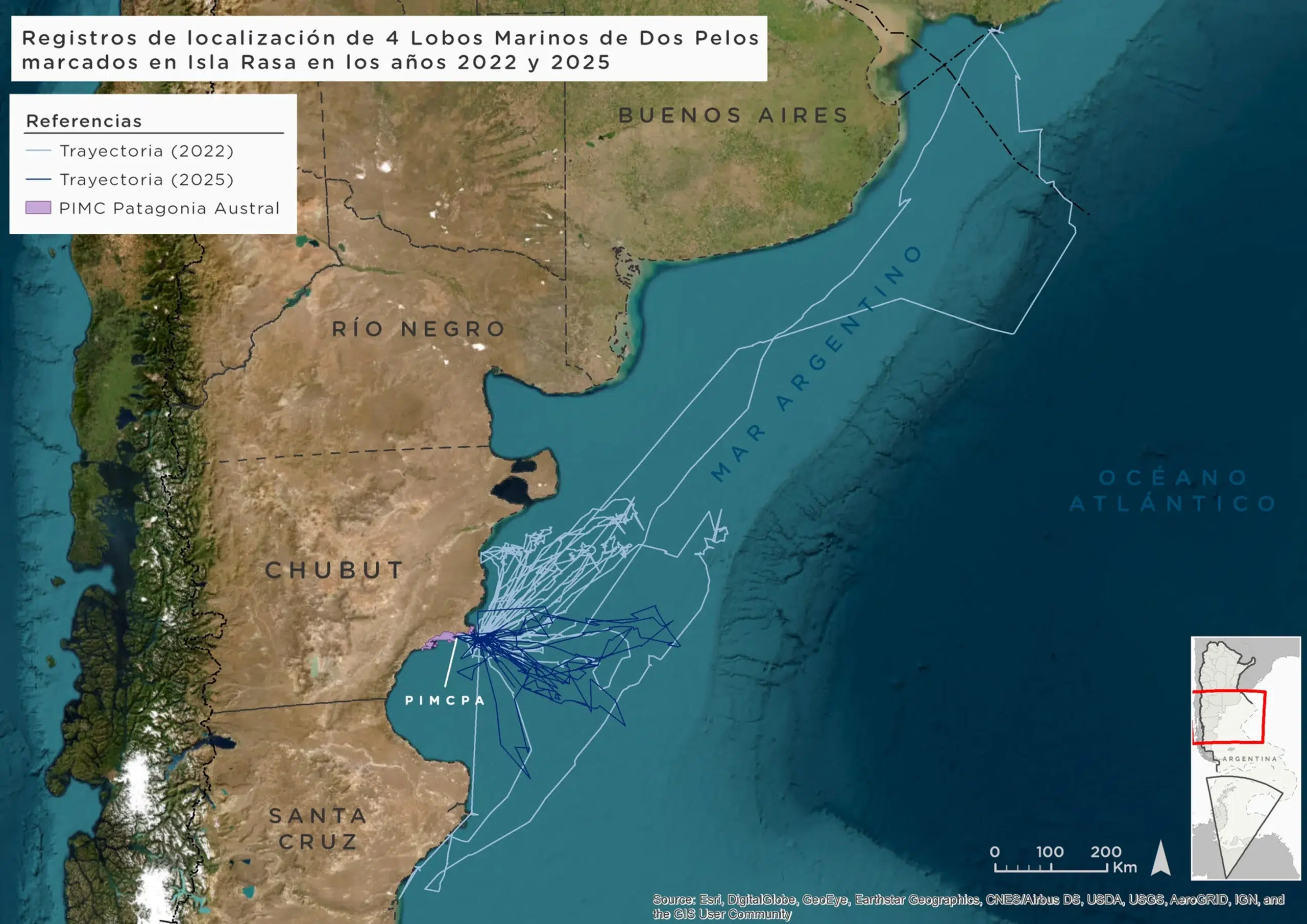
The **Patagonia Azul** team has been **tracking** these animals using **satellite devices**, creating a **dynamic map** that **reveals unexpected marine routes**.
*”A female we tagged on Isla Rasa traveled over 1,400 kilometers to Uruguay and returned in less than a month. That shows that these colonies are not ecological islands, but are interconnected by corridors we never imagined,”* he comments.
## Superviviente de la caza y símbolo en recuperación
The story of the **two-haired sea lion** in Argentina is that of a **resilient species**.
For **centuries**, it was **intensely hunted** for its **skin and fat**, drastically reducing its **population** to near extinction in the **20th century**.
*”It was on the verge of disappearing. Today we see fragmented populations that are slowly advancing, but still retain immense biological value,”* emphasizes **Nacho**.
In 2023, Chubut took a fundamental step by declaring it a **Provincial Natural Monument**, a category that **strengthens its protection** and places it at the **center of conservation policies**.
## Guardianes del océano y reguladores del ecosistema
Beyond its charisma, this **top predator** plays a **vital ecological role**, regulating the population of **fish, squid, and other marine species**.
Gutiérrez describes their behavior underwater with an almost **poetic term**:
– Marsupéo, the movement in which the animal emerges in small jumps while quickly advancing.
– A phenomenon also performed by penguins, seeming to fly underwater.
Some individuals can go **weeks without returning to solid ground**, living in a **parallel universe, invisible to almost everyone**.
*”Sometimes you wonder: how many other species are out there, living their lives without anyone noticing them?”* reflects **Nacho**.
## Investigaciones que permiten recuperar su lugar
The **Patagonia Azul** team, from **Isla Rasa**, is creating a **unique database** on their movements, behavior, and **relationship with the marine ecosystem**.
It has already been determined that:
– They can travel more than 1,000 kilometers in a few weeks.
– Their dives on the continental slope position them as key predators in deep waters.
## Importancia estratégica de su conservación
These findings are **fundamental** to establish **more effective protection measures**.
*”The more we understand their dynamics, the clearer the impact they have on the trophic chains of the Argentine Sea,”* concludes **Gutiérrez**.
The **two-haired sea lion** not only **returns to lost territories**, but its preservation will ensure the **balance of a fragile ecosystem** that is constantly changing.

