



The expedition “Underwater Oases of Mar del Plata Canyon”, promoted by Conicet, caused a huge stir on social media thanks to the live streaming of images from the ocean floor. The most discussed finding was that of a strange fish with a ghostly appearance, nicknamed by users as the “telescope fish.”
Although the viral video was not directly taken from the official broadcast, its dissemination coincided with the peak of popularity of the streaming. The creature surprised with its enormous mouth, semi-transparent skin, and front-facing eyes, characteristics reminiscent of creatures from science fiction movies.
The specimen belongs to the Giganturidae family, known as “swallowers” fish, inhabitants of oceanic depths. These fish, living between 500 and 3000 meters below the sea, remain little known due to the difficulty of studying such extreme environments.
Its appearance captured the attention of the general public, generating all kinds of humorous reactions on social media, from memes to ironic phrases. Meanwhile, the official broadcast continues to reveal amazing species from the Mar del Plata Canyon.
Technology in Deep Waters: Science Front and Center
The expedition represents a milestone for Argentine science. For the first time, a remotely operated vehicle capable of capturing images in high definition without altering the environment is being used in the national waters of the Southwestern Atlantic.
This type of tool allows for the exploration of inaccessible areas and the collection of biological samples with great precision. This expands the knowledge about little-known ecosystems and enables the detection of new species or behaviors.
The Mar del Plata Canyon, off the coast of Buenos Aires, is a key area due to its biological richness. Cold and temperate waters intersect there, creating a unique environment that promotes biodiversity in the South Atlantic.
The expedition and the public interest it generated reinforce the importance of investing in ocean science. The massive dissemination of its results can inspire new scientific vocations and strengthen marine conservation in the country.
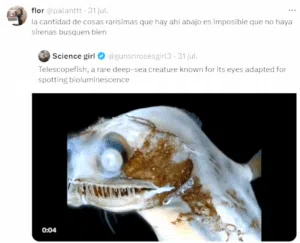
A Creature Adapted to the Oceanic Abyss
The swallowers fish present unique adaptations to life in deep waters. The most striking is their disproportionate jaw, capable of expanding to devour prey larger than their own body.
This strategy allows them to survive in environments with limited food availability. Their elongated, compressed body ending in a filament facilitates efficient movement in the darkness of the ocean.
The front-facing eyes and large size suggest acute vision in dim light, crucial for hunting in extreme conditions. Although their appearance is intimidating, these fish measure between 15 and 21 cm and pose no danger to humans.
Thanks to the expedition, species like this gain visibility. Studying them could provide valuable data on how life evolves in one of the most mysterious environments on the planet. And at the same time, continue to arouse curiosity—and memes—from the depths.



