



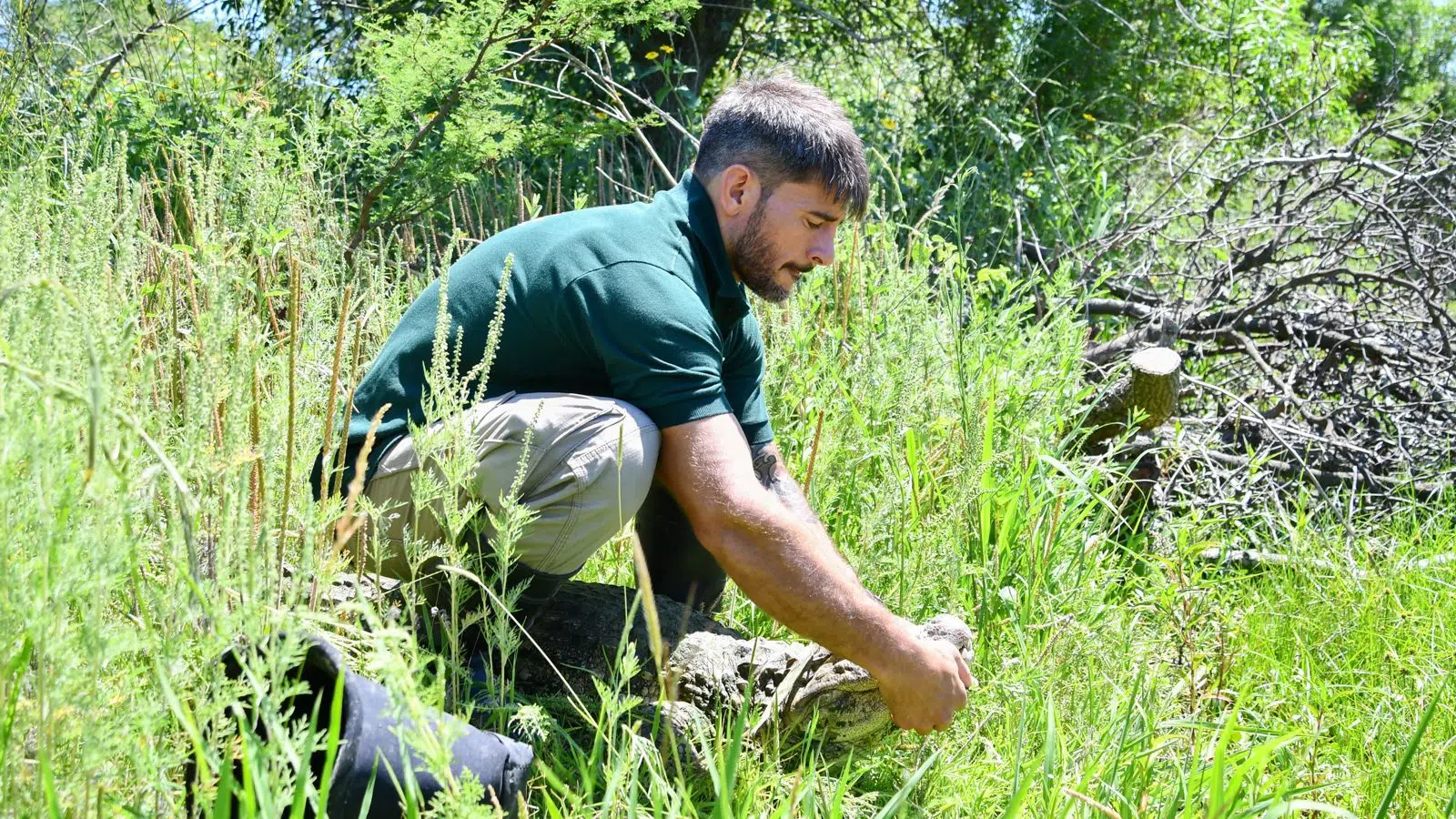
In the province of Santa Fe, the Ministry of Environment and Climate Change announced the release of “Ricardito”, a broad-snouted caiman (Caiman latirostris) that spent more than a decade in conditions outside its natural environment.
The animal had been found in a private home, then transferred to the Malbrán Institute in Buenos Aires, and finally sent to the La Esmeralda Wildlife Rescue, Research, and Interpretation Center (CRIIF), where it underwent its recovery process. The reintegration was completed in a protected area, after months of veterinary and behavioral monitoring.
From the domestic pool to the protected area
The case gained notoriety when it was revealed that the broad-snouted caiman had lived in a domestic space with a small pool, an unsuitable environment for its species.
The judicial intervention that allowed its transfer was driven by the Specialized Environmental Prosecutor’s Unit (UFEMA), with support from the Judicial Investigation Corps of the Public Prosecutor’s Office of CABA, the Wildlife Area of the Federal Police, and the Buenos Aires Ecopark.
During its stay at CRIIF, “Ricardito” was evaluated by an interdisciplinary team that monitored its health, nutritional, and behavioral status. Although it did not have any diseases, it lacked the necessary behaviors to survive in the wild.
The rehabilitation included weight recovery and readaptation to natural habits, a process that required several months of work.
A public conservation policy
The provincial environmental department emphasized that the reintroduction of wildlife is a strategic, albeit complex, conservation tool.
“This release is not just an emotional or symbolic event: it is the concrete result of a public policy that chooses to act with scientific evidence, institutional responsibility, and commitment to life,” stated Enrique Estévez, Minister of Environment and Climate Change of Santa Fe.
CRIIF specialists pointed out that in reptiles like caimans, the difficulty of reintroductions is often underestimated. A release without technical criteria can lead to high mortality or negative impacts on other species.
Therefore, the team ensured that “Ricardito” developed behaviors typical of the species, could feed itself, and move independently. Additionally, the chosen site had to have optimal conditions, avoiding contact with wild populations to reduce health or genetic risks.
A case that highlights the issue of wildlife
The story of “Ricardito” brought the issue of illegal wildlife trafficking and possession back to the agenda, a matter that requires responsible institutional and judicial responses. The collaboration between provincial authorities, federal agencies, and CRIIF made the rescue, rehabilitation, and release operation possible.
At the time of its transfer from Buenos Aires, the animal exhibited habits incompatible with wildlife, a consequence of its prolonged contact with humans. Adapting its diet, weight recovery, and gradual exposure to a controlled environment were key to its successful reintegration.
The Ministry of Environment and Climate Change of Santa Fe highlighted that this procedure is part of a public policy oriented towards conservation and based on science. “When working with evidence, protocols, and professional teams, second chances are not a gesture: they are part of an active commitment to conservation,” the authorities emphasized.



