



For decades, South Korea allowed the breeding of bears for bile extraction. However, this week the country confirmed its definitive elimination, in response to a sustained social and environmental demand.
Thus, starting in January 2026, the activity will be prohibited by law and criminal sanctions will be imposed on those who violate the rule. In this way, the State reinforces its commitment to wildlife protection.
Although the decision marks a turning point, the process is complex, as there are still hundreds of animals in captivity. For this reason, the transition requires coordinated ecological and ethical measures.
A new legal framework to protect wildlife
The ban is supported by a comprehensive reform of animal welfare. Consequently, it will no longer be allowed to breed or possess bears for extractive purposes, bringing the country closer to international conservation standards.
At the same time, a six-month grace period was established. During this time, it will be monitored to ensure there is no bile extraction. Afterwards, any violation will be punished by law.
In this way, the State seeks to order the closure of the sector. It is not only about prohibiting but also about supervising, thus preventing the practice from continuing in a clandestine manner.
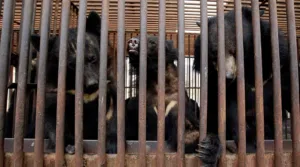
The fate of bears still living on farms
Currently, about 200 bears remain on private farms. Therefore, their situation is one of the major concerns for the Government and civil organizations, which are working together for their relocation.
Some specimens have already been transferred to state sanctuaries. However, the capacity of these facilities is limited, so activists are calling for the creation of more protection spaces.
Meanwhile, the State offers financial support to breeders. The goal is to ensure the care of the animals until their transfer and thus, attempt to reduce the immediate impact of the industry’s closure.
What bear bile is used for in South Korea
Traditionally, bear bile was used in oriental medicine. It was attributed anti-inflammatory and analgesic properties and was considered a tonic to increase vitality.
Over time, it was also incorporated as a functional food. However, its medical effectiveness began to be questioned, leading to more accessible synthetic and plant-based alternatives.
As a result, the consumption of bile decreased significantly. Currently, its use is no longer central in modern medicine, which facilitated the social consensus to end the practice.

A social agreement that drove the change
The definitive closure is based on an agreement reached in 2022. Authorities, farmers, and environmental organizations participated, reaching a consensus and setting a clear date for the end of the activity.
Since then, some breeders have accepted state compensations. Others, however, question the amounts offered. Even so, the majority committed to comply with the law.
This agreement allowed progress without major conflicts. Additionally, it opened the debate on more sustainable production models. Thus, animal welfare was integrated into the public agenda.
An ecological advance with long-term impact
Ending bear breeding for bile reduces animal suffering. But it also strengthens the conservation of a vulnerable species. Moon bears play a key role in forest ecosystems.
By protecting them, the natural balance is also preserved. Seed dispersal and forest health are benefited. Therefore, the impact goes beyond each rescued individual.
Finally, the decision sends a clear message. The relationship between society and nature is changing. And South Korea takes a firm step towards more ethical environmental management.



