



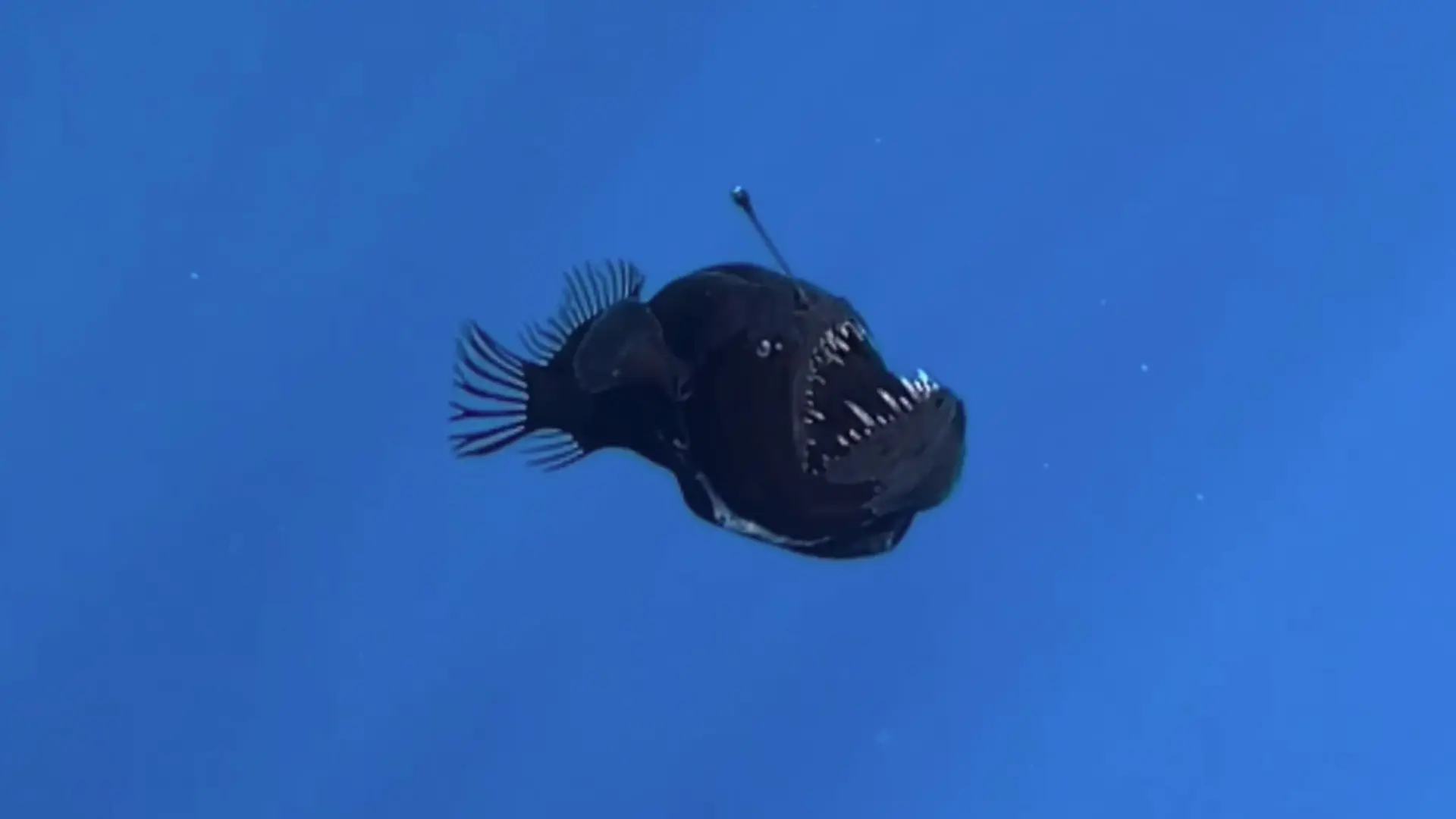
The sighting of a black seadevil fish (Melanocetus johnsonii) in shallow waters, captured on video by the NGO Condrik Tenerife, amazed the scientific community.
This deep-sea predator, known for its bioluminescent lure used to attract prey, emerged in broad daylight just two kilometers off the coast of Tenerife, an unprecedented event.
The unexpected outcome of the black seadevil fish
Days after the discovery, the fish died, closing with a tragic ending one of the strangest observations of marine life.
Biologist Laia Valor, who was part of the team documenting the event, told La Vanguardia that the animal was not in good health at the time of the sighting.
Until now, records of this species were limited to larvae, dead specimens, or captures made with submarines at depths of up to 2,000 meters.
Scientific mystery and theories
The reason why this abyssal fish emerged in such shallow waters remains a mystery. Experts propose several theories, such as a possible illness, changes in water pressure, upwelling currents, or fleeing from a predator.
“It’s hard to answer with certainty, as these species inhabit areas where conditions are extremely stable,” explained Marcelo Oliva, a researcher at the Millennium Institute of Oceanography, to CNN Chile.
Another hypothesis suggests that it could have been regurgitated by another marine animal, which would explain its arrival at the surface. However, without further studies, determining the exact cause remains challenging.
Adaptations and curiosities of the black seadevil fish
Despite its terrifying appearance, the black seadevil fish is harmless to humans.
Its life in the depths has led to surprising adaptations, such as the fusion of males with females to ensure reproduction.
This extreme reproductive strategy reinforces its image as one of the most fascinating creatures of the ocean.
Opportunity for science
The death of this specimen is a loss for biodiversity, but it also represents an opportunity for scientists.
Its sighting on the surface could be a signal of changes in deep-sea marine ecosystems, highlighting the importance of continuing to explore and protect life in the deep sea.
Have you visited our YouTube channel yet? Subscribe now!


