



From the El Unco Biological Station, located in the heart of the Patagonian steppe, Fabián Oswald leads the logistical coordination that allows carrying out the most complex animal conservation operations in remote areas. While science guides the decisions, his work ensures that everything runs smoothly: animal transfers, corral assembly, route planning, supply of resources, and the design of equipment adapted to each species.
Even in the early hours of the morning and under a cutting cold, Fabián starts his truck. In the distance, the corral of Cañadón Caracoles awaits, where coypus will be reintroduced into the riverbed in a few hours.
The tasks at El Unco begin with mate, a meticulous review of materials, and an operational mechanism that makes possible the return of wild animals to territories they had lost.
“The focus is usually on specialists, but behind every decision, there is a logistics team that supports everything that happens in the field,” explains Fabián, who also manages infrastructure, builds transfer devices, and designs each element to guarantee the well-being of the intervened species.
Innovation in species transfer and collective conservation work in Parque Patagonia
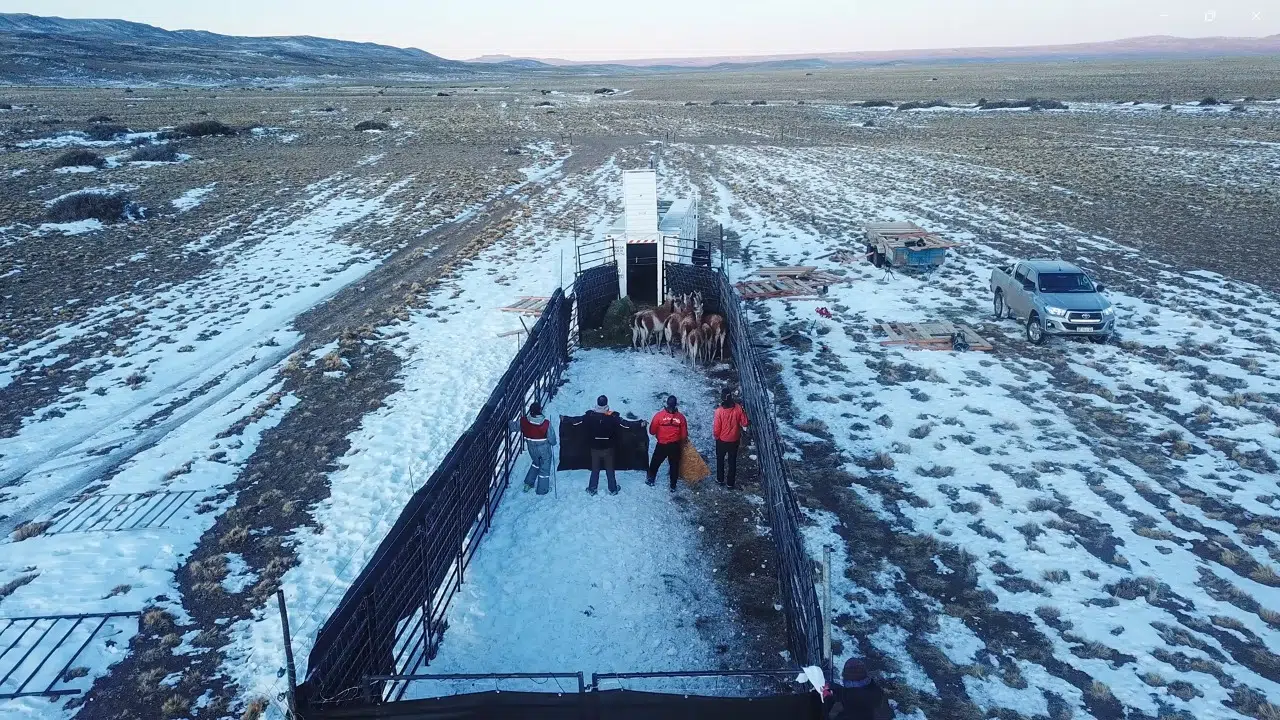
From trailers designed for guanacos to adapted boxes for rheas, mountain viscachas, and coypus, each tool responds to the specific conditions of the terrain and the natural behavior of the animals. “Listening to and understanding what each species needs is key. Everything must be fast, efficient, and respectful,” says Fabián.
One of the most memorable challenges was the transfer of guanacos to La Pampa, a process that required continuous testing, adaptation of structures, and handling adverse situations, such as a broken axle in the middle of the night, which they solved as a team. “Seeing them reclaim a space that once belonged to them generates tremendous satisfaction,” he recalls.
Although originally from Misiones, Fabián found his purpose in Santa Cruz. From Perito Moreno, he works on the development of protected areas and participates in projects that have even led him to reintroduce rheas in Chile as part of a binational plan.
“The commitment of the group is what I value the most. Even with wind, snow, or cold, we all pull together. Knowing that my work helps stop extinction and mitigate climate change is what drives me,” he affirms.
In every image where scientists are seen interacting with wildlife, the invisible work of people like Fabián is also present, making everything work outside the spotlight. His story demonstrates that species conservation not only depends on science but also on those who turn ideas into reality in the field.


