



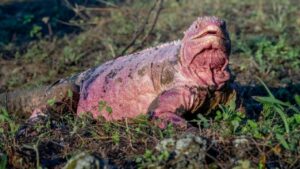
At the summit of the Wolf Volcano in the Galapagos Islands, one of the rarest species in the world resides. The pink iguana, officially identified in 2009, lives solely in this sector of Isabela Island, within an extremely limited territory.
Its habitat is limited to about 1.25 kilometers on the slopes of the volcano. This restricted distribution makes the species one of the most vulnerable on the planet. If it disappears from that location, it would become extinct.
Currently, scientists estimate there are between 200 and 300 individuals. Although they can live up to 60 years, their slow reproduction hinders the recovery of the population.
Unlike other iguanas in the region, each female lays between 4 and 7 eggs per season. In comparison, the yellow iguana can lay up to 25 eggs, highlighting the reproductive fragility of the pink species. Therefore, each birth represents hope for its survival.
Invasive predators threaten reproduction
The greatest risk to pink iguanas comes from species introduced to the islands centuries ago. Rats and feral cats arrived with sailors, pirates, and whalers, profoundly altering the island ecosystems.
These animals locate nests by smell and feed on both eggs and newly hatched young. This problem particularly affects juveniles, who cannot defend themselves during the first years of life.
The most critical stage occurs between birth and four years of age. Only after this period do individuals reach a size sufficient to face some predators.
The incubation of the eggs also presents challenges. It can last between 100 and 170 days and depends on stable thermal conditions close to 30 degrees. For this reason, iguanas dig deep nests that maintain the necessary temperature for embryonic development.
Distinctive characteristics of the pink iguana
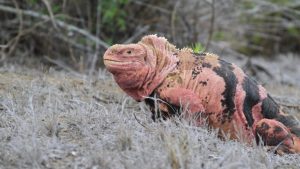
The pink iguana has features that clearly differentiate it from other species in the archipelago. Its most striking characteristic is the pink coloration of its skin, crossed by dark bands running along its body.
This unusual hue is due to genetic particularities that make it a unique species within the Galapagos ecosystem. Its geographic isolation also contributed to its differentiated evolution. Additionally, it is a herbivorous reptile that primarily feeds on local vegetation. Its diet includes leaves, fruits, and shoots that grow in the volcanic areas of Wolf Volcano.
Through its feeding, the pink iguana fulfills an important ecological function. As it moves through the territory, it disperses seeds that promote plant regeneration. This process also benefits other emblematic species of the archipelago, such as the giant tortoises, which depend on vegetation for their diet.
Conservation and challenges on Wolf Volcano
The protection of the pink iguana requires constant work in an extremely demanding geographic environment. The Wolf Volcano rises to about 1,700 meters, and access involves long hikes in variable climatic conditions.
Scientific teams stay for several days in camps set up on the mountain to monitor the species. From there, they conduct tours to locate nests and control invasive predators.
The control of rats and cats is carried out through traps, protected baits, and camera traps that allow identifying their presence. These tools help to reduce pressure on the nests. The research also includes genetic studies and ecological monitoring aimed at better understanding the evolution of the species.
However, threats are not limited to invasive predators. Volcanic activity, competition for food with other species, drought, and climate change influence its survival. Despite these challenges, the coordinated work of scientists and conservation organizations maintains hope of preserving one of the most extraordinary species of Galapagos.



