



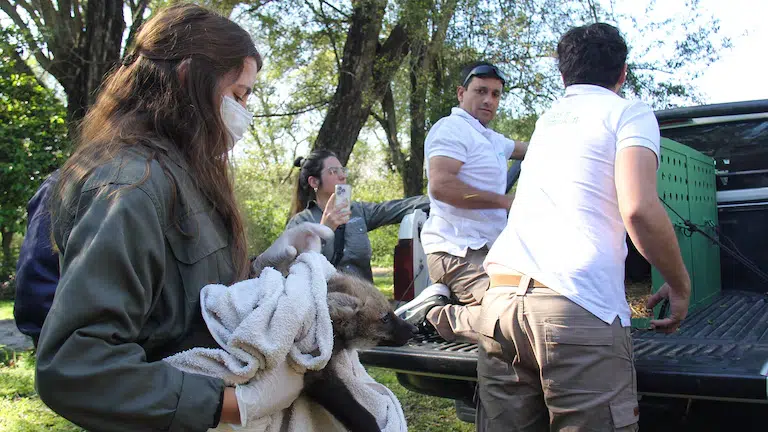
Two maned wolf puppies, Kuarahy and Jasy, were rescued in the Esteros del Iberá, in Corrientes, when they were just 45 days old. After being found without their mother, they received care from the Rewilding Argentina Foundation and were later transferred to the Temaikèn Species Recovery Center, where they are undergoing a crucial rehabilitation process for their return to the wild.
The program’s goal is for the animals to grow in controlled conditions, without direct human contact and with all the necessary skills to survive in the wild. At the center, specialists monitor their development through veterinary checks and behavioral analyses that ensure their well-being and progressive adaptation to the wild environment.
Each step in their recovery is crucial: these specimens represent a concrete hope for the conservation of the largest canid in South America, an emblematic species facing an alarming reduction of its habitat and a constant threat from the loss of natural ecosystems.
The work of the Temaikèn Foundation not only aims to return animals to their original environment but also to restore the ecological balances that are compromised by agricultural expansion, poaching, and the illegal wildlife trade.
The maned wolf: symbol of the forest and victim of human encroachment
The maned wolf (Chrysocyon brachyurus) originally inhabits the grasslands, savannas, and marshes of northeastern Argentina. Its distribution covers Corrientes, Chaco, Formosa, Santa Fe, Misiones, Santiago del Estero, northern Córdoba, and Entre Ríos, although recent records show a shift towards marginal areas, even up to northern Buenos Aires, in search of refuge.
This shift evidences an increasingly severe habitat fragmentation process. The transformation of the landscape for intensive soybean and corn cultivation, recurrent forest fires, and urban expansion reduce the areas available for its feeding and reproduction.
Currently, the species is classified as “near threatened” by the International Union for Conservation of Nature (IUCN). Although its distribution is wide, the populations are naturally small and scattered, making them vulnerable to habitat loss and diseases transmitted by domestic dogs.
The maned wolf can weigh between 20 and 30 kilos and measure up to 1.40 meters long. Its omnivorous diet—based on fruits, small mammals, and birds—makes it a natural ecosystem regulator. Its disappearance would have profound ecological consequences in the wetlands and forests of northern Argentina.

25 years of active conservation
The Temaikèn Foundation celebrates 25 years working on the conservation and restoration of Argentine biodiversity. Over this time, it has received more than 16,000 wild animals, prioritizing the care of species at risk such as the yellow cardinal, the red macaw, and the maned wolf itself.
The conservation program includes actions in Patagonia, Misiones, and Buenos Aires, aiming to strengthen biological corridors and ensure the continuity of ecosystems. Its approach combines rehabilitation, research, and environmental education, promoting a more harmonious coexistence between human communities and native wildlife.
The recovery of Kuarahy and Jasy not only represents a veterinary triumph but also a reminder of the ecological value of the maned wolf as an umbrella species: by protecting it, the environments that sustain it are also protected.
In a context of global environmental crisis, these rescue initiatives and reintegration become a concrete response to the loss of biodiversity. The survival of these two puppies symbolizes a small-scale victory, but with a huge ecological and cultural impact for the future of Argentine wildlife.



