



The illegal trade of rare spiders from Brazil, such as the “jewel” tarantula, shows a sustained increase. Furthermore, demand in Europe and North America drives this activity.
Consequently, species of the Typhochlaena genus have become a target for collectors. Therefore, pressure on small populations is growing.
Likewise, wildlife trafficking ranks among the most lucrative illegal businesses. Thus, it moves billions of dollars globally.
On the other hand, the lack of records complicates its control. As a result, the actions of illegal networks are strengthened.

A vulnerable ecosystem under threat
The affected tarantulas inhabit the Atlantic Forest. Moreover, this ecosystem is one of the most biodiverse in Brazil.
However, it is also one of the most degraded ecosystems, causing various species to face multiple threats.
In turn, illegal capture worsens the situation, as it reduces the recovery capacity of populations, while pressure on limited habitats increases the risk. Therefore, the loss of biodiversity accelerates.
An expanding global illegal market
Interest in exotic pets is growing in international markets. Additionally, tarantulas stand out for their striking appearance. For this reason, their value in the illegal market increases, and therefore, their extraction intensifies.
Moreover, clandestine postal shipments facilitate trafficking, causing specimens to reach distant destinations.
In turn, this method complicates controls, making illegal trade a more complex problem to stop.
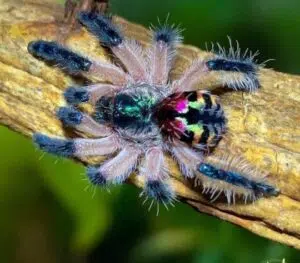
Characteristics of the Typhochlaena genus tarantulas
The species of the Typhochlaena genus are known as “jewel spiders”. Additionally, they display metallic colors on the abdomen.
In fact, these features make their appearance highly attractive. Therefore, they arouse interest among collectors.
Likewise, they are small, arboreal tarantulas that live in trees within the Atlantic Forest. There are only five known species of these spiders, all endemic to Brazil.
Finally, some, like Typhochlaena curumim, are in critical condition. Therefore, their conservation is urgent.
The urgency of strengthening environmental protection
The illegal trade poses a direct threat to these species. Additionally, it compromises the balance of ecosystems.
Consequently, experts call for greater international cooperation. Therefore, efforts are being made to curb this trade.
Likewise, it is necessary to strengthen controls. Thus, the actions of illegal networks are limited. On the other hand, expanding scientific research is crucial. Consequently, the protection of little-studied species is improved.
Finally, the conservation of the Atlantic Forest is essential. Therefore, protecting these tarantulas means safeguarding a unique ecosystem.


