



The depths of the Patagonian sea hold key ecosystems for marine biodiversity. This was recently recognized internationally: two regions in Chubut were declared “priority” for the conservation of sharks and rays.
These are Bahía Engaño and the northern Gulf of San Jorge. They were selected by the International Union for Conservation of Nature (IUCN) as Important Areas for Chondrichthyans (ISRA).
This international designation recognizes these areas as essential for the survival of sharks, rays, and ratfish.
Critical areas for key species of the marine ecosystem: what happens with sharks and rays
The initiative is part of a global project that seeks to map the essential habitats of chondrichthyan fish, a group of vertebrates that includes sharks, rays, and chimaeras.
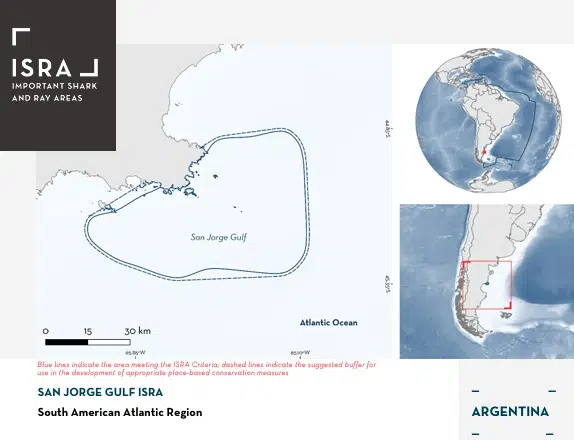 The San Jorge region.
At this stage, the study focused on the Atlantic coast of South America, a region with high ecological value and still underrepresented in global maps of marine conservation.
“These ISRA are delimited areas that fulfill key ecological functions such as reproduction, feeding, or egg-laying. They are spaces where these species return year after year to ensure their offspring,” explained Nelson Bovcon, a researcher at UNPSJB and CONICET, specialized in Patagonian fish.
Bahía Engaño: a multi-species breeding area on the coast of Rawson
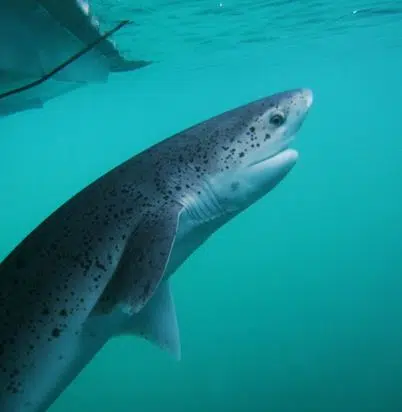 The shark, another essential species.
Bahía Engaño, located near Rawson, is considered a true “natural maternity ward” for several marine species. Fish such as the smooth-hound, school shark, ratfish, and different species of rays like the thornback and the marbled ray reproduce simultaneously there.
What is remarkable about this area is that some species lay eggs, while others give birth to live young, and many of these remain in the area for months.
This phenomenon makes it a multi-species breeding area, an unusual trait even at a global level.
Gulf of San Jorge: a mosaic of underwater biodiversity
To the south of Bahía Engaño, the northern Gulf of San Jorge was also included as an ISRA. In this area of high biological richness, at least four shark species, five ray species, and ratfish have been identified, all using the area as a reproductive habitat.
Among the highlighted species is the roughskin skate (Dipturus trachyderma), one of the largest in the Argentine sea, which lays its eggs in these waters. Juveniles of the snubnose ray, another large species, were also detected.
Additionally, there are species whose conservation status is not critical yet, but they pose a challenge to science due to the limited knowledge about their biology.
A designation with ecological, political, and economic impact
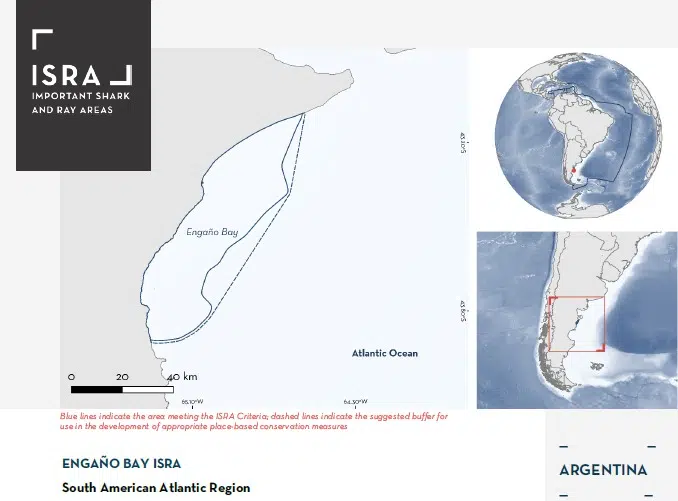 The Bahía Engaño region.
The official recognition by the IUCN is not merely symbolic: it implies that human activities, especially industrial fishing, must be adjusted to reduce their impact on these sensitive areas.
<p"Having a recognized ISRA raises the sustainability standard. Many fisheries, such as shrimp fishing, are evaluated based on their impact on these areas," noted Bovcon.However, the conservation of migratory species such as the school shark, which travels long distances from Brazil to Patagonia, faces governance challenges between different jurisdictions and countries.
The hidden value of the Patagonian sea
In the region, more than 28 chondrichthyan species are recorded, many with concerning conservation status. Some are present year-round, others only during the summer. Among them are rare species like the thresher shark or the rough skate.
The selection of Bahía Engaño and the Gulf of San Jorge as priority areas for marine conservation positions Argentinian Patagonia on the global map of strategies for marine biodiversity.
“The most remarkable thing is that these are multi-species breeding areas. In many places around the world, only one species uses an area for reproduction. Here, several do. That makes them true biological treasures that we must protect,” Bovcon concluded.


