



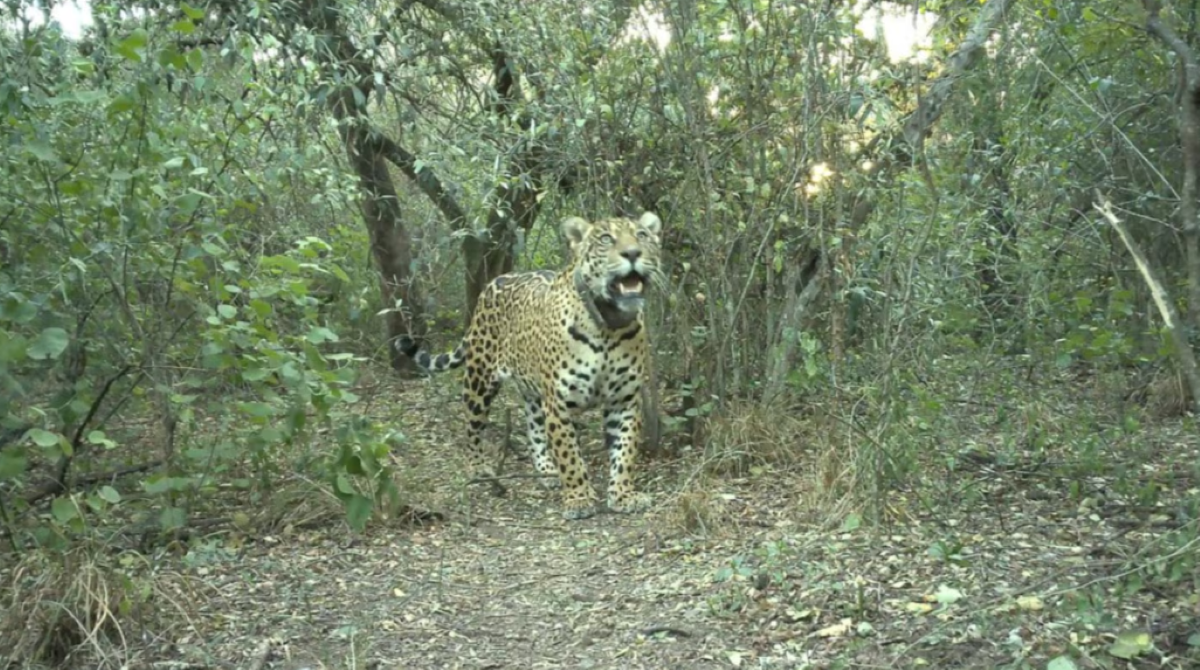
More than two months have passed since the disappearance of Acaí, a young jaguar released in the El Impenetrable National Park, and little is known about her.
Twenty days after her arrival in Chaco, on October 25, her satellite collar stopped emitting signals and shortly after was found submerged in the Bermejo River. Since then, there has been no further news of the animal.
Acaí’s disappearance opened a judicial case and prompted a 250 million pesos reward for information about her fate.
In Argentina, there are fewer than 250 wild specimens, and their habitat has shrunk by 95%, making each loss a critical blow to the species’ survival.
Suspicions and open cases
Organizations like Rewilding Argentina and Red Yaguareté maintain that Acaí was hunted and discarded, possibly after attacking a pet or work animal.
The residents of the Manantiales area are pointed out as suspects. Hypotheses related to the clandestine fur trade or even the trafficking of live specimens are also considered.
The national Ministry of Justice estimated the environmental damage from Acaí’s loss at more than 2.6 billion pesos. It also reminded that the jaguar is a National Natural Monument. Attacking its life constitutes a crime under the Penal Code, with penalties of up to five years in prison.
The “Acaí massacre”
The Rewilding Foundation spread the news as the “Acaí massacre”, pointing out that the satellite collar was thrown into the river to hide evidence.
Despite the severe blow, the organization and authorities committed to strengthening the reintroduction project and supporting the search for those responsible to ensure they receive the punishment established by law.
The context: extinction in Chaco
Acaí’s story connects with the reintroduction process started in Corrientes, where the jaguar was extinct between 1953 and 2021. Thanks to the project in the Iberá National Park, the species began to reproduce freely again, and the province became a “donor” of specimens for other ecosystems.
Acaí was born in Iberá and was transferred to El Impenetrable, where wild females have been extinct for over 30 years. Her release was key to recovering the population in this dry forest, considered the second most important in South America after the Amazon due to its size and biodiversity.
Qaramta and reintroduction efforts
Attempts to recover the jaguar in Chaco began in 2019 when the tracks of a solitary male, Qaramta, were recorded on the banks of the Bermejo. In the absence of females, he was crossed with captive specimens from Iberá, resulting in cubs that were later released.
Between 2024 and 2025, four females were released in El Impenetrable: two daughters of Qaramta born in captivity, one rescued in Paraguay, and Acaí. The arrival of females was essential for the species to reproduce naturally in the region.
A species in critical danger
In Argentina, the jaguar has lost more than 95% of its original distribution area, and it is estimated that fewer than 200 individuals remain in fragmented populations.
Acaí’s disappearance reflects the fragility of conservation projects and the urgency of strengthening protection against poaching and habitat loss.
The question “What happened to Acaí?” continues to resonate in the Chaco forest. Her disappearance exposes the tensions between conservation and local practices but also reaffirms the need to sustain reintroduction projects.
Each lost specimen is a reminder that the future of the jaguar depends on the joint action of communities, governments, and environmental organizations.



