



Every January 20th, Penguin Awareness Day highlights the 19 species that inhabit the planet. In the Argentine Patagonia, this date invites us to review how these birds coexist with an expanding nature tourism.
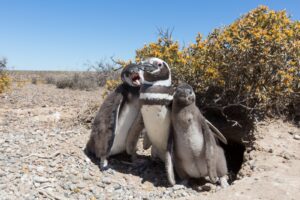
In this scenario, the Patagonian or Magellanic penguin becomes the protagonist. Its presence supports local economies but also exposes tensions between conservation and recreational use of the territory.
Therefore, understanding the effects of tourism is key to protecting the species in the long term. Comparing colonies offers clear signals about which practices work and which need to be reviewed.

Punta Tombo and San Lorenzo: two models, different impacts
In the province of Chubut, Punta Tombo and San Lorenzo host the most important colonies in the country. Both share species and coastal landscape, although they show very different tourist trajectories.
Punta Tombo has been receiving visitors since the 1970s and today attracts between 100,000 and 120,000 people a year. In contrast, San Lorenzo opened to tourism about two decades ago and maintains controlled entries, with about 10,000 annual visitors.
This difference is reflected in the state of the colonies. While San Lorenzo maintains more stable dynamics, Punta Tombo shows signs of sustained pressure.
Animal health and accumulated human pressure
Studies reviewed show that in Punta Tombo, physiological alterations were detected in adults and chicks. Among them are signs of prolonged stress and changes in indicators related to immunity.
Additionally, higher levels of parasitism and metabolic variations were observed in specimens exposed to the constant flow of people. Thus, the impact is not immediate but cumulative and persistent.
In San Lorenzo, however, no relevant adverse effects were recorded. Management with small groups and guided tours seems to reduce the risks to the colony.
Keys to nature-compatible tourism
Researchers propose concrete measures to reduce the impact. Limiting visitors, organizing tours in small groups, and adjusting schedules are central.
They also recommend elevated walkways, strict zoning, and trail rotation. In this way, vegetation is protected and the natural regeneration of the habitat is favored.
Environmental education and permanent monitoring complete the strategy. Thus, tourism can become an ally of conservation.
The species and its conservation status
The Patagonian or Magellanic penguin inhabits the coasts and archipelagos of Argentina and Chile. It feeds on fish, squid, and crustaceans, and forms large breeding colonies on beaches and cliffs.
In Argentina, it is distributed from Río Negro to Tierra del Fuego. Punta Tombo is home to about 140,000 breeding pairs, while San Lorenzo hosts about 210,000.
At the regional level, the species is not considered critically endangered, but it faces growing threats. Climate change, industrial fishing, and poorly managed tourism require strengthening conservation policies.
Caring for penguins involves rethinking how we visit their territories. The balance between enjoyment and protection will define the future of one of the most recognized symbols of southern Argentina.

