



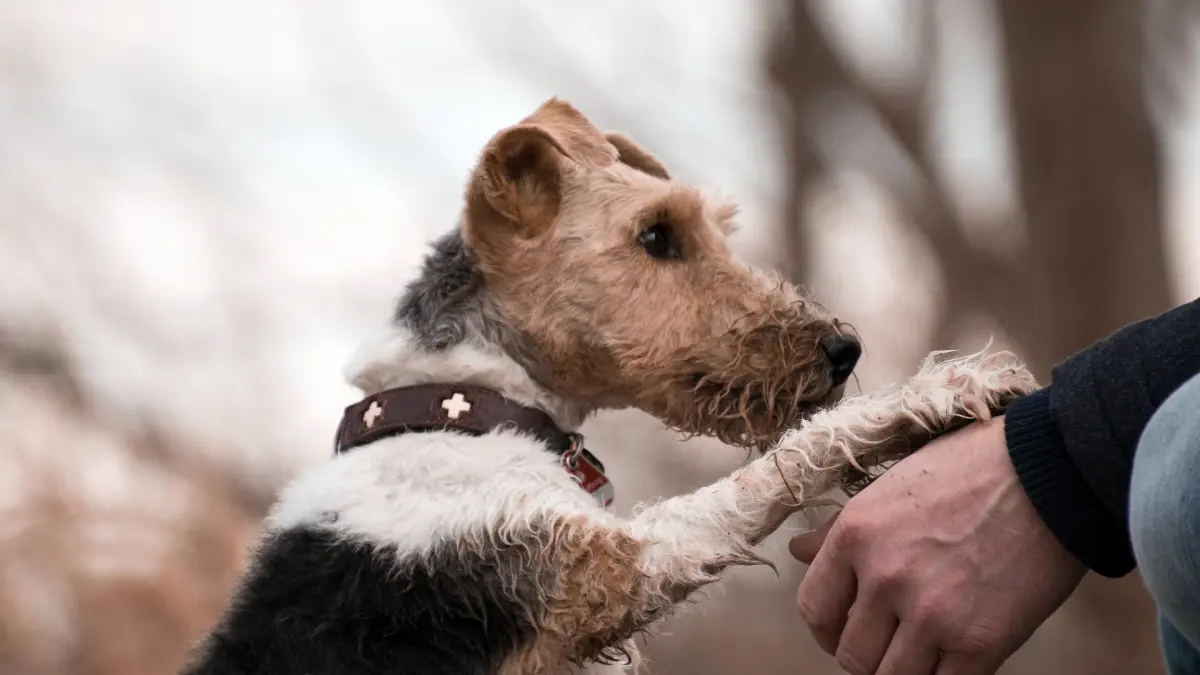
One thing is for a trained dog to give us its paw when we ask for it, and quite another for it to do so on its own initiative.
This difference, seemingly subtle to the human eye, is essential from the animal’s perspective and reveals a lot about how dogs communicate with us and their environment.
Paws as body language
Anyone who lives with a dog knows that their paws are almost a language of their own: they can place one on their human’s arm, gently push a leg, give a light touch on the thigh, or even scratch insistently to demand attention.
There is no single way to do it nor a single reason behind the gesture. What does exist is a clear communicative intention. Dogs don’t move their paws randomly: they use them to express what they can’t say with words.
Instinctive origin of the gesture
In its most basic form, the paw movement is associated with survival. Puppies do it at birth, pushing their mother’s belly to stimulate milk production.
Over time, this reflex action transforms into a social tool: the dog learns that when it raises its paw, “something happens.” Thus, many adults use it to ask for food, demand attention, or show affection. But reducing it to a simple demand would fall short: the paw also expresses complex emotions, from anxiety to tenderness.
A basic form of communication
According to animal behavior specialists, placing a paw on someone is not a habit learned randomly, but a vestige of the dog’s most primitive communication.
Dogs don’t have hands, but they do have a complex body repertoire that includes the gaze, posture, ears, tail… and, of course, paws. Using them allows them to initiate contact, ask for something, or establish a bond.
Context and meaning
In practice, it is often interpreted as a request:
- A dog may place its paw on its caregiver’s arm because it wants to play.
- It may do so because it wants to go out.
- Or simply because it seeks closeness and affection.
The gesture is usually accompanied by a sustained gaze, tail movement, or changes in body posture, reinforcing the message.
The power of physical contact
Dogs quickly learn that physical contact has a direct effect: if they touch, someone responds. That association, reinforced time and again, turns the gesture into an effective communication tool.
Sometimes the message is as simple as “look at me.” In those cases, ethologists recommend redirecting the behavior towards positive alternatives: a walk, a search toy, or a few minutes of directed attention.
Signs of affection or alert
Not every paw gesture means the same. Context is key:
- A relaxed dog that rests its paw while being petted may be showing affection and trust.
- If the gesture is accompanied by body tension, averted gaze, or accelerated breathing, it may indicate nervousness or discomfort.
- Raising a paw without touching anything can be a sign of alert or stress.
- Using the paw to push, rather than caress, can express a desire for distance.
Correctly interpreting these signals requires observing the entire body language and not just the isolated movement.
The paw as an emotional bond
Beyond needs or stress, many dogs use the paw as a form of emotional contact. Resting it on the human’s arm or leg, especially during a petting session or a moment of rest, should be understood as a manifestation of attachment.
Neurochemical studies have shown that the bond between dog and person activates neurotransmitters like oxytocin, serotonin, and dopamine, the same ones that reinforce social bonds in humans. In this context, the paw doesn’t ask for anything: it simply offers companionship.
When to look more closely
A dog that insists on touching, scratching, or pushing may be showing frustration, anxiety, or even physical pain. In those cases, it is advisable to consult with a veterinarian or canine behavior specialist to rule out medical or emotional causes.
The paw gesture is much more than a cute action: it is a body language loaded with meaning. It can express affection, need, alert, or discomfort, and its interpretation depends on the context and the rest of the body’s signals.
Understanding it allows us to strengthen the bond with our dogs and respond appropriately to their emotional and physical needs.



