



For decades, the rural landscape of Tierra del Fuego was linked to sheep production. However, this balance began to break due to the expansion of wild dogs, becoming an environmental and productive problem advancing over the Fuegian rural identity.
In steppe areas and, above all, in forests, attacks have become recurrent. As a result, sheep have ceased to be viable in large areas. This has forced the modification of historical production schemes.
Moreover, the phenomenon did not stop there. Over time, the attacks also extended to cattle and calves. Thus, the crisis ceased to be sectoral and became structural.
The decline of sheep production and the change in land use
Just over a decade ago, the province had about a million sheep. Then, that number steadily fell to below 300,000. This decline profoundly altered the rural economy.
Currently, sheep production only persists in the open steppe. In contrast, the forest and ecotone have become ideal refuges for wild dogs. Therefore, many ranches have permanently abandoned the activity.
As a result, there has been a change in land use. Some farms have been sold and converted to other purposes. Thus, the shepherding trade began to disappear from the Fuegian cultural landscape.
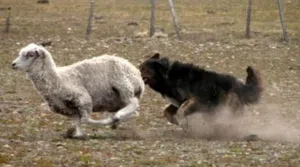
From sheep to cattle: a conversion with limits
Faced with constant losses, several producers opted to replace sheep with cattle. Mainly, Hereford breed animals were introduced, better adapted. However, this alternative also presents restrictions.
The number of cattle in the province is limited by the extreme climate. Long, cold winters impose a productive ceiling that is difficult to overcome. Additionally, dog attacks also affect calves.
In many cases, dogs do not attack to feed. However, the stress causes falls into rivers and streams. Thus, indirect losses multiply silently.
An ecological problem that worsens over time
The population of feral dogs is estimated at about 25,000 heads. They organize into packs, reproduce uncontrollably, and avoid human contact. Therefore, their management is complex.
The Fuegian forest offers shelter, food, and cover. This favors the expansion of the dogs and makes their control difficult. Thus, the conflict persists and deepens year after year.
Meanwhile, producers, municipalities, and scientific institutions seek solutions. Interinstitutional coordination appears as a possible path. However, the results are still incipient.
Characteristics of wild dogs and their role in ecosystems
Feral dogs are domestic animals that have returned to wild life. They lose their bond with people and develop group hunting behaviors. This makes them efficient predators.
Among the ecological advantages, they can control populations of some species. They also occupy niches left by absent large predators. In certain contexts, they contribute to trophic dynamics.
However, the negative impacts outweigh the benefits. They attack sheep, cattle, and calves, altering productive systems. Additionally, they displace native fauna and generate ecological imbalances.
Therefore, their unmanaged presence represents an environmental problem. The challenge is to find strategies that reduce damage without exacerbating the conflict. The balance between conservation and production is key.

Beyond production: social and cultural effects
The loss of the sheep activity is not only economic. It implies the abandonment of ranches, infrastructure, and historical knowledge. Thus, the rural social fabric is weakened.
The younger generations migrate to other activities. It is increasingly difficult to find labor for the field. The morale of those who remain is affected.
Even traditional events reflect this change. Rural exhibitions that once showcased sheep now only exhibit cattle. The Fuegian productive landscape has been completely transformed.
An environmental challenge that demands comprehensive responses
The conflict with wild dogs combines ecological, productive, and social dimensions. It does not allow for simple or immediate solutions. Therefore, it requires long-term planning.
The responsible management of canine populations appears as a central tool. So do prevention, education, and reproductive control. In this way, the aim is to reduce impacts without deepening tensions.
In the far south of the country, the challenge is clear. Restoring the balance between nature and production is urgent. The future of the Fuegian landscape depends on it.



