



Humanity has been dreaming for centuries of capturing natural energy and storing it for later use. The sun, an abundant but intermittent source, poses a challenge: it shines during the day, but our energy needs are constant.
So far, the dominant solution has been to convert sunlight into electricity and store it in batteries, with high costs and efficiency losses.
The Californian Innovation
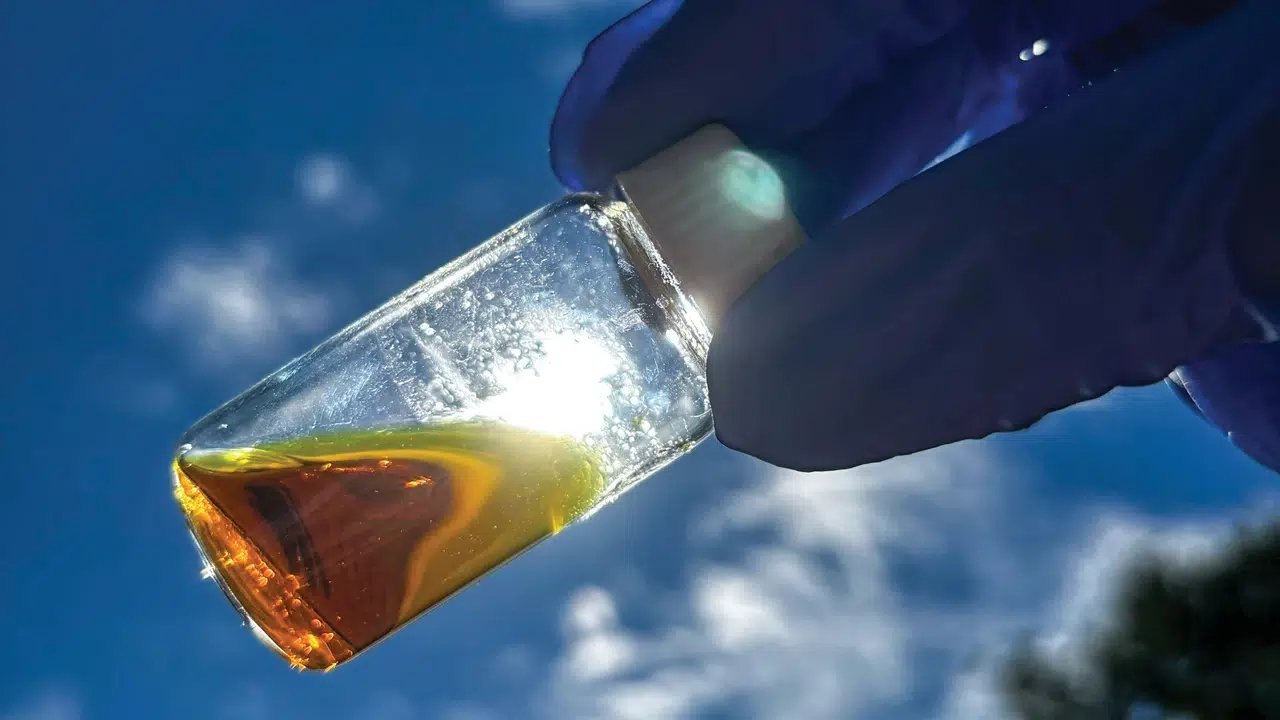
Researchers from the University of California, Santa Barbara, led by Associate Professor Grace Han, have developed a molecular solar-thermal storage (MOST) system. The core of the technology is a liquid with modified pyrimidinone molecules that react to sunlight:
- Upon receiving light, the molecules change shape and become charged with energy, like a microscopic spring.
- They can remain in that state for more than a year (481 days) without losing energy.
- When heat is needed, simply apply a stimulus (heat or acid catalyst) and they release the accumulated energy.
The cycle can be repeated indefinitely, turning the liquid into a reusable and stable solar energy storage.
Performance and Testing
The laboratory results are compelling:
- The released heat was sufficient to boil water under ambient conditions, demonstrating its practical power.
- The energy density reaches 1.6 MJ per kilogram, approximately double that of a conventional lithium-ion battery.
- Being a liquid, scalability is simple: just increase the volume of solution and store it in tanks or pipes.
- Potential Applications
The possibilities for use are broad:
- Homes: sanitary hot water, heating, and reducing energy bills.
- Industry: decarbonizing low and medium temperature thermal processes.
- Seasonal storage: storing solar energy in summer and using it in winter, something difficult with electric batteries.
- Hybrid systems: integration with photovoltaic, solar thermal, and heat pumps.
Its use is even contemplated with thermoelectric generators, which would allow electricity production on demand.
Advantages over Batteries
This system eliminates losses associated with the double conversion of electricity-chemical-electricity. Moreover, it does not depend on critical materials like lithium or cobalt, making it a more sustainable alternative and less dependent on complex supply chains.
The liquid developed in California represents a quiet yet key advancement for the energy transition. It will not replace all batteries, but it can fill a critical gap: clean, durable, and reusable thermal storage. Its success on a real scale could transform the way we harness every ray of the sun, offering practical solutions for homes, industries, and cities.



