



In the coastal province of Guangdong, in southern China, a new silhouette dominates the marine horizon: hundreds of wind turbines rise in the South China Sea as part of an ambitious strategy to decarbonize the country.
Some towers reach the height of 30 stories, and the region already concentrates almost 15% of all offshore turbines in the world. In the next five years, the local government plans to double that fleet.
Energy versus storms: the challenge of typhoons
These installations are located in one of the most typhoon-exposed areas on the planet, tropical cyclones that hit East Asia between May and November with winds exceeding 240 km/h, as happened with typhoon Ragasa in September.
“It is crucial that the turbines not only withstand the typhoons but also harness their prior gusts,” explains Zhu Ronghua, director of the Yangjiang Offshore Wind Energy Laboratory.
Standards, certifications, and structural resilience
China established standards for “typhoon-type” turbines capable of withstanding sustained winds of 198 km/h for 10 minutes. Internationally, the International Electrotechnical Commission (IEC) proposes guidelines for “typhoon-class” turbines that withstand 205 km/h sustained and gusts up to 290 km/h.
Although these standards are not mandatory, many turbines have demonstrated real resilience in extreme conditions, even without formal certification.
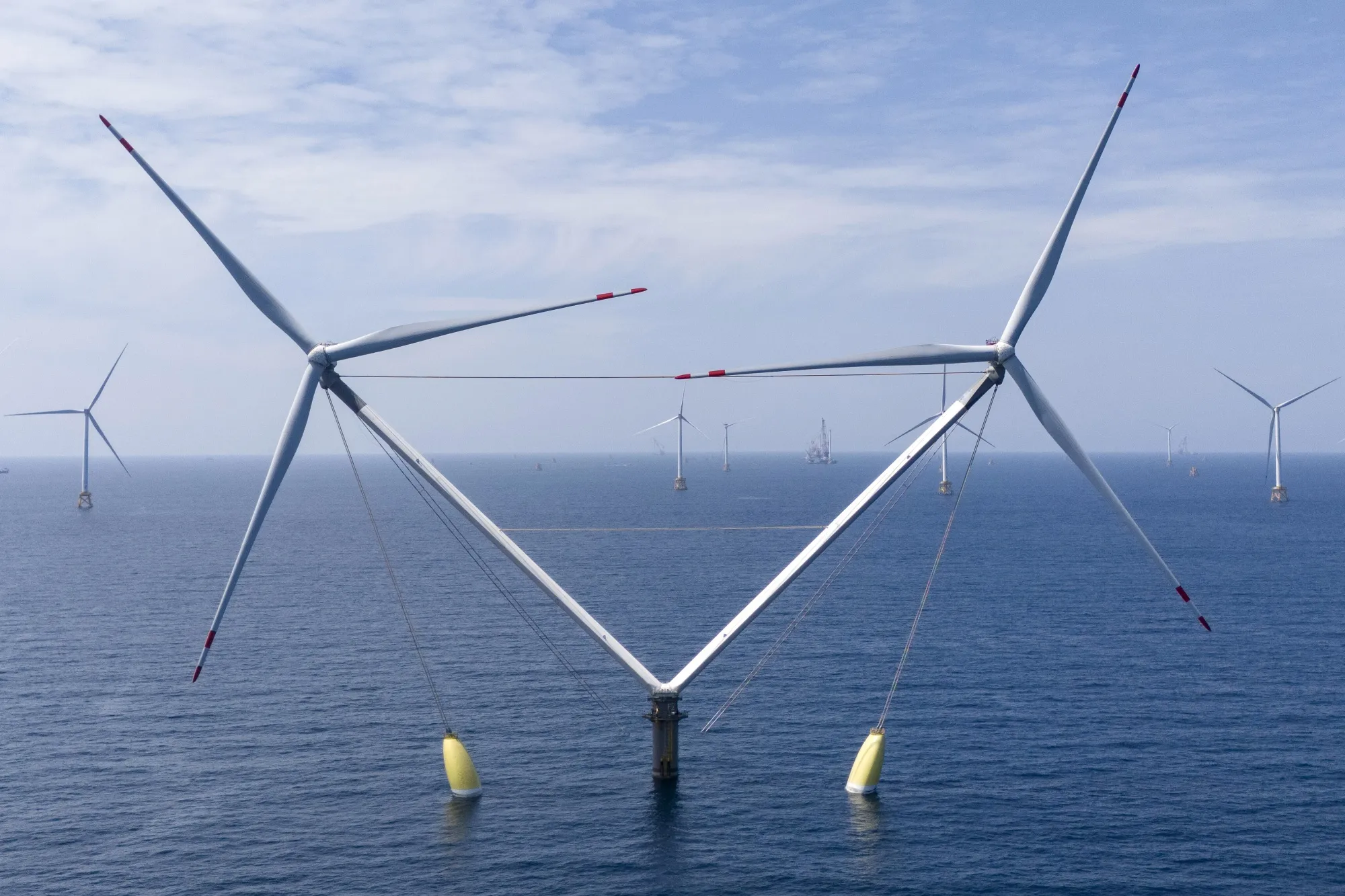
OceanX: floating platform with dual turbine and ultra-resistant concrete
One of the most notable innovations is the OceanX model, developed by Mingyang Smart Energy. This floating platform supports two turbines that rotate in opposite directions, allowing for a 4.29% increase in energy conversion.
- Flexible anchoring: the base is tied to a single point on the seabed, allowing it to align with the wind
- Ultra-high-performance concrete: four times stronger than conventional, withstands pressures of 115 MPa
OceanX withstood winds of up to 152 km/h during the passage of typhoon Ragasa, according to the lead designer Wang Chao.
Goldwind: advanced monitoring and reinforced materials
The company Goldwind managed to have 47 turbines withstand 161 km/h for six hours, generating 2.1 GWh in nine hours, enough to supply 800 British homes for a year.
The key was the use of carbon fiber, early warning systems, and real-time monitoring, which allowed for dynamic adjustments to abrupt wind changes.
Persistent risks and lessons learned
Not all turbines withstood. In Wenchang (Hainan), typhoon Yagi destroyed seven newly installed turbines that were not yet connected to the grid, preventing their active protection.
Economic losses could reach 66 million dollars, according to estimates by the China Property and Casualty Reinsurance Company.
Future adaptations: flexible blades and leeward design
Researchers like Lucy Pao (University of Colorado) propose blades placed behind the motor, inspired by flexible palm trees, which could be made with more economical materials and withstand gusts without collapsing.
Between 1980 and 2020, the number of typhoons that rapidly intensify near the coast tripled, according to recent studies. This forces the redesign of turbines with interchangeable components and region-specific strategies, especially on islands with weak power grids.
China leads offshore wind resilience
With 170 GW of new offshore wind capacity projected for the next decade, and 60% located in typhoon zones, China positions itself as a global leader in turbines resistant to extreme phenomena. Its experience can be key for other regions in Southeast Asia facing similar challenges.
“Tropical cyclones are a threat, but also an opportunity to innovate,” concludes Xiaoli Guo Larsén, professor at the Technical University of Denmark.



