



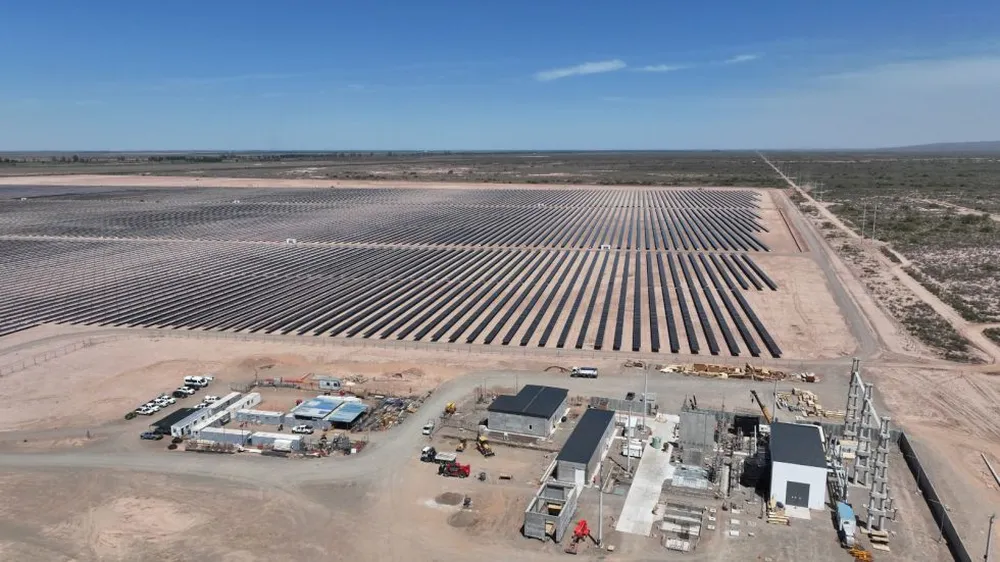
The El Quemado Solar Park, inaugurated in Las Heras (Mendoza), is established as the largest in the country and the first approved under the Incentive Regime for Large Investments (RIGI).
With 620 hectares in the middle of the Mendoza desert and more than 518,000 bifacial panels, the park takes advantage of one of the areas with the highest solar radiation in the country.
The installed capacity reaches 305 MW, divided into two stages:
- Stage I: 200 MW.
- Stage II: 105 MW additional.
The energy generated is equivalent to the consumption of more than 233,000 homes, enough to cover the residential demand of Mendoza, Las Heras, and Lavalle.
Cutting-edge technology
The El Quemado Solar Park incorporates bifacial solar panels, capable of generating energy on both sides:
- They capture direct sunlight on the front side.
- They utilize the radiation reflected on the ground on the rear side.
Additionally, the panels rotate from East to West, following the daily solar arc, which maximizes energy efficiency.
The project included the construction of a GIS transformer station, a double-bar substation, and an outlet for three 220 kV/33 kV transformers, in addition to 180 km of fiber optics to integrate control and protection systems. The energy is injected into the Argentine Interconnection System (SADI) and is marketed through the Term Energy Market (MAT).
Investment and economic model
The project required 220 million dollars, becoming the “flagship” of the economic model promoted by the national government under the RIGI. The initiative was developed by EMESA (Mendocina Energy Company) and was acquired and built by YPF Luz.
Strategic importance of solar energy
Solar parks in Argentina are key for the energy transition and the diversification of the productive matrix:
- High natural potential: regions like Jujuy, Salta, and Catamarca offer ideal conditions.
- Energy security: they reduce dependence on fossil fuels.
- Economic development and employment: they generate jobs and boost rural economies.
- Environmental sustainability: they reduce the carbon footprint and protect ecosystems.
- Profitability: more than 25 years of useful life and significant savings for industrial users.
- Distributed generation: allows injecting surpluses into the grid, reducing electricity bills by between 50% and 90%.
Investment context in 2026
- Projected investments: US$ 4.5 billion to transform the energy matrix.
- Regulatory framework: Law 27.191 and RIGI as drivers of large-scale projects.
- Regional leadership: San Juan contributes 31.9% of the national solar energy.
- Pending challenge: expand the electric transport capacity to connect new parks.
El Quemado symbolizes the energy future of Argentina: a project that combines technological innovation, strategic investment, and environmental sustainability. Its inauguration marks a milestone in the transition to a cleaner and more diversified matrix, positioning the country as a regional leader in solar energy.


