



Researchers from the National Renewable Energy Laboratory (NREL) in the United States have introduced the ULIS (Ultra-Low Inductance Smart), a silicon carbide-based power module that enhances efficiency, reduces costs, and offers record power density.
This development aims to transform critical sectors such as data centers, electric vehicles, advanced aviation, and military systems.
The global demand for electricity is rapidly increasing, driven by artificial intelligence, the expansion of manufacturing, and electrified transportation. In this context, ULIS does not seek to generate more energy but rather to better utilize existing energy, converting more available electricity into usable energy.
Technical Features
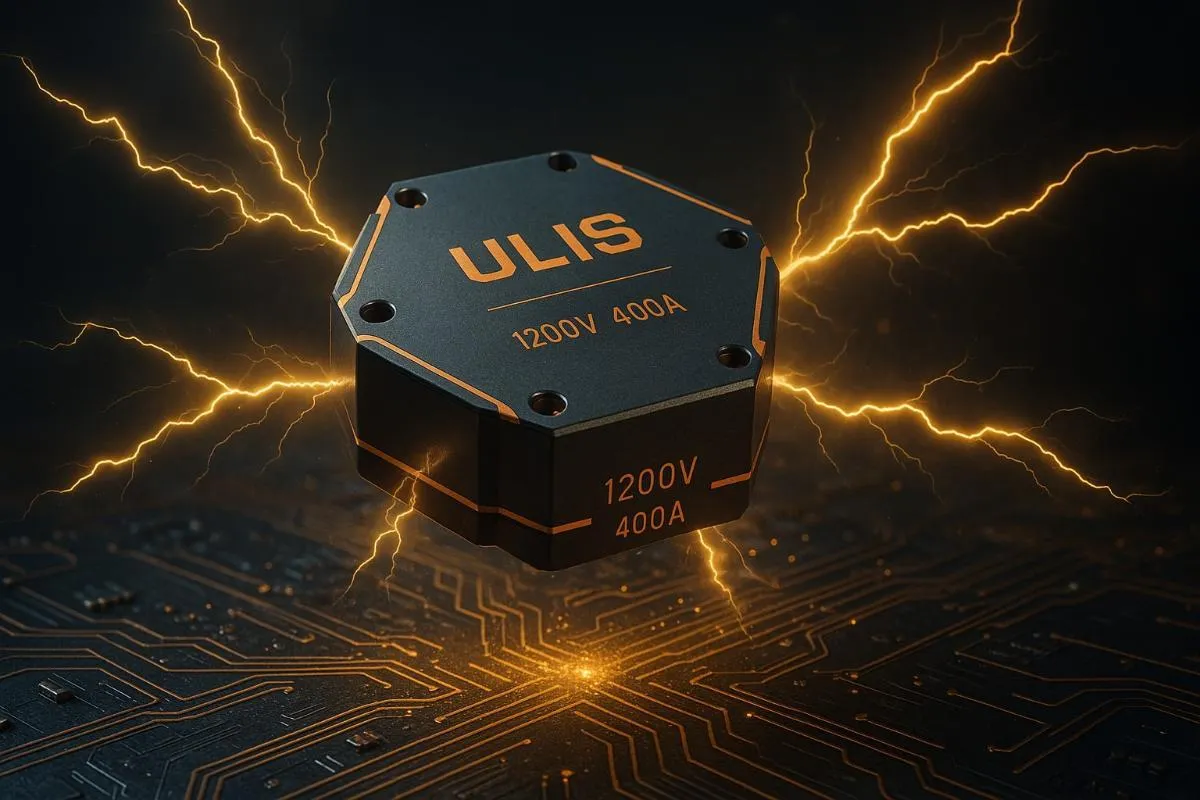
The ULIS module operates at 1200 volts and 400 amperes, with an energy density five times greater than previous models. Among its advantages:
- Ultra-low parasitic inductance, reduced by seven to nine times compared to the most advanced modules on the market.
- Flat octagonal design, allowing more components to be included in less space, reducing size and weight.
- Optimized current path, minimizing magnetic interference and improving efficiency.
- Autonomous monitoring, capable of anticipating component failures before they occur.
- Low-latency wireless communication, allowing the module to be controlled and monitored without physical cables.
Innovations in Materials and Manufacturing
ULIS deviates from conventional materials. Instead of bonding copper to rigid ceramic bases, it uses a flexible polymer called Temprion, resulting in a thinner, lighter, and more adaptable structure. This material is bonded to copper through heat and pressure, reducing manufacturing costs to hundreds of dollars instead of thousands.
The modular design, similar to Lego pieces, facilitates its integration into multiple systems. Additionally, ULIS is prepared to evolve towards future semiconductors like gallium nitride and gallium oxide, expanding its application potential.
Impact on Different Sectors
- Electric grid: improves energy conversion efficiency and reduces maintenance costs.
- Data centers: allows for more compact and efficient equipment, essential to support artificial intelligence.
- Electric aviation (eVTOL): enables lighter and more powerful converters, bringing the commercial viability of vertical take-off electric aircraft closer.
- Defense and military operations: offers reliability in high-risk environments, with early fault detection.
- Nuclear fusion: its ultra-low inductance and durable design make it suitable for compact and reliable pulsed power systems.
ULIS represents a technological leap in power electronics, with the capacity to transform how electricity is managed in strategic sectors. Its compact, efficient, and adaptable design makes it a key component for a more reliable and sustainable energy future.



