



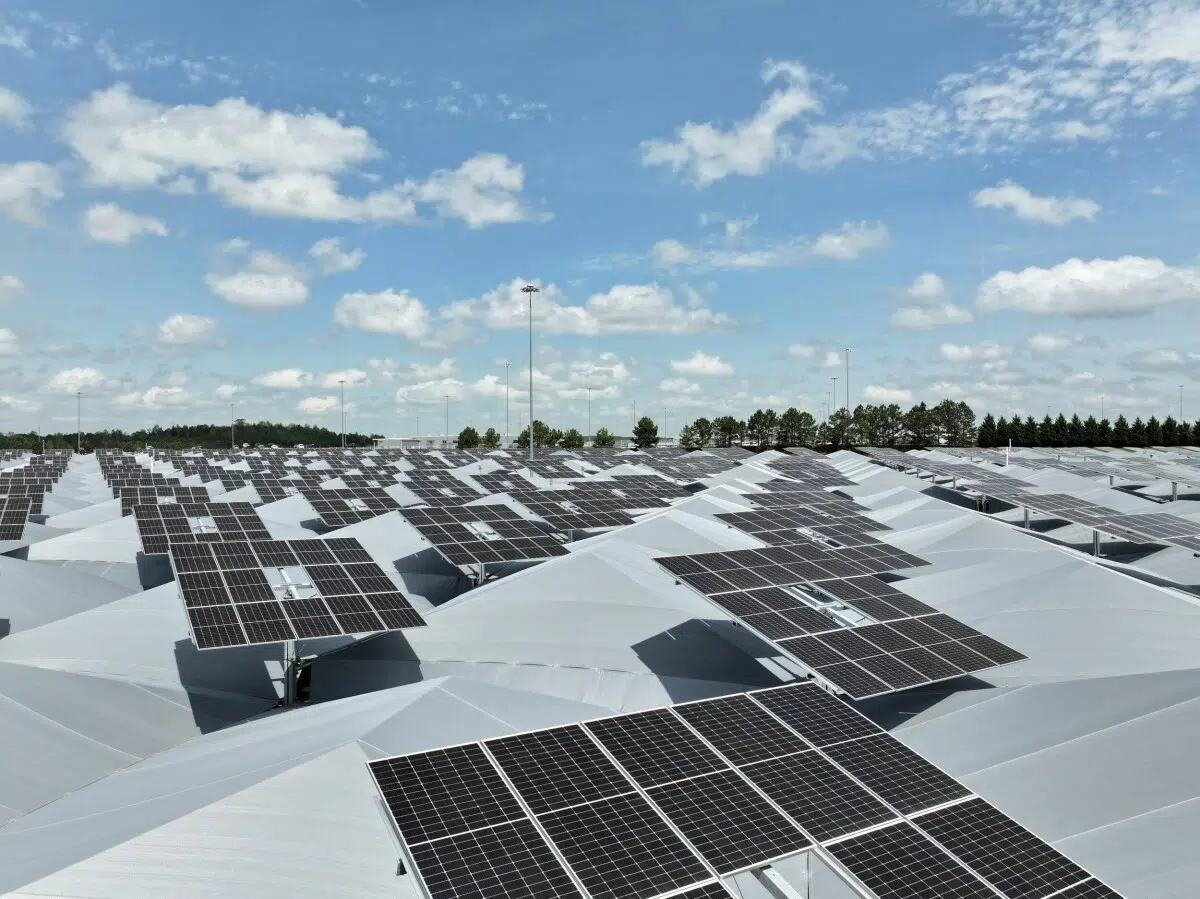
The South Korean company **Kia** implemented a structural and energy solution at its **Georgia plant (United States)**, after suffering million-dollar losses due to a **hailstorm that damaged 13,000 newly manufactured vehicles in 2023**. The automaker **transformed its parking lot into a medium-scale solar installation**, designed to **generate clean energy** and protect the infrastructure from **extreme weather events**.
The new system — developed by the company **Vehicle Protection Structures (VPS)** — will cover **297,000 square meters** with **17,000 photovoltaic panels**, capable of generating up to **13 megawatts (MW)** of power.
This energy volume represents between **20 and 30% of the total plant’s consumption**, allowing to **power industrial processes and reduce transportation emissions** and storage.
## Climate resilience and clean energy integration
Unlike conventional structures, the VPS solution **protects vehicles from hail, extreme sun, and other weather events**, while **acting as an electric generator**.
This industrial integration is part of a long-term strategic vision: Kia’s **global climate plan**, which aims to reduce **97% of carbon emissions by 2045** compared to 2019 levels.
The project, though without official investment figures, is part of the **Inflation Reduction Act**, US legislation passed in 2022 that **provides tax benefits** to companies developing **sustainable infrastructures and renewable energies**.
This framework allows initiatives like Kia’s to be **environmentally responsible and economically viable**, with a medium-term profitability perspective.
## Industrial application and sectorial reference
The Georgia plant produces electric vehicles like the **EV6 and EV9**, as well as combustion models like the **Sorento, Sportage, and Telluride**. Incorporating solar generation in this mixed context demonstrates that **energy transition is possible even in complex and diversified environments**.
Companies like **Tesla, Amazon, and Microsoft** are also adopting similar solutions, integrating renewables into their industrial operations. Kia’s case can serve as a reference for industries with **large outdoor storage areas**, especially in areas prone to **hail, hurricanes, fires, or floods**.



