



A team of researchers led by **Xin Wen** at the **Xi’an Jiaotong University (China)** managed to demonstrate that **salty ice is not only a crystalline solid**, but also **flexoelectric**: it can **generate electricity** when subjected to pressure or mechanical bending.
Although this phenomenon had already been hinted at in [moving glaciers](https://noticiasambientales.com/medio-ambiente/glaciares-en-retroceso-una-amenaza-creciente-para-los-ecosistemas-andinos-y-la-seguridad-hidrica/), the electrical signal was too weak to be exploited… until now.
## The role of salt: unlocking hidden currents
The key to the breakthrough lies in **sodium chloride (NaCl)**. By adding salt to water before freezing it, the researchers **increased a thousandfold the generated electricity** when bending the ice.
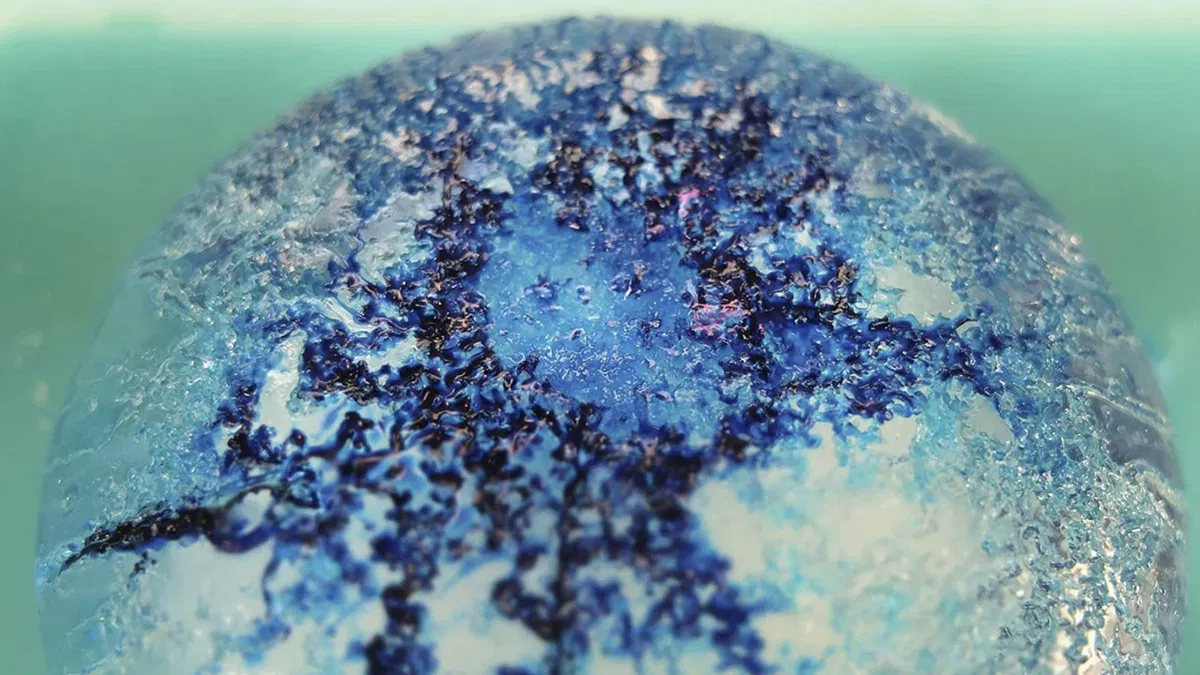
Through **advanced microscopy and Raman spectroscopy**, they discovered that salt prevents homogeneous freezing, forming **liquid microchannels** that, when deformed, **displace dissolved charges** and generate a **streaming current**.
This phenomenon converts **mechanical pressure into usable electrical energy**, opening up the possibility of **harnessing icy surfaces as natural generators**.
## Applications on Earth: clean energy in polar regions
From autonomous sensors to the replacement of **diesel generators**.
Although [energy efficiency](https://noticiasambientales.com/energia/buenos-aires-sera-sede-de-la-proxima-reunion-del-comite-tecnico-152-de-copant-sobre-eficiencia-energetica-en-la-region/) is still low and devices suffer from **structural fatigue** after multiple cycles, the potential is considerable. In regions like **Greenland, the Canadian Arctic, or Antarctica**, this technology could:
– **Complement or replace diesel generators**
– **Integrate into smart infrastructures** with sensors powered by ice movement
– **Harness wind pressure** at polar scientific stations
## Beyond the planet: energy on icy moons in the solar system
Europa and Enceladus could become **natural laboratories** for this technology.
The implications of the study go beyond Earth. Moons like **Europa (Jupiter)** and **Enceladus (Saturn)**, where the existence of **oceans under layers of salty ice** is suspected, could be **ideal environments to explore this phenomenon**.
NASA and ESA already include them in their plans for **astrobiological exploration**, and if flexoelectricity is confirmed on those bodies, we could generate energy **on-site**, without the need to transport batteries or solar panels.
## Future perspectives: hybrid materials and energy autonomy
Ice ceases to be a barrier and becomes an **active resource**.
Despite its current limitations, this technology offers **a new way of thinking about ice** as an **active material** within sustainable energy systems. Some ideas for application include:
– **Emergency generators** in polar areas
– **Flexible structures with artificial salty ice**
– **Low-power environmental sensors**
– **Autonomous equipment for planetary exploration**
– **Hybrid materials** that extend lifespan without losing energy capacity



