



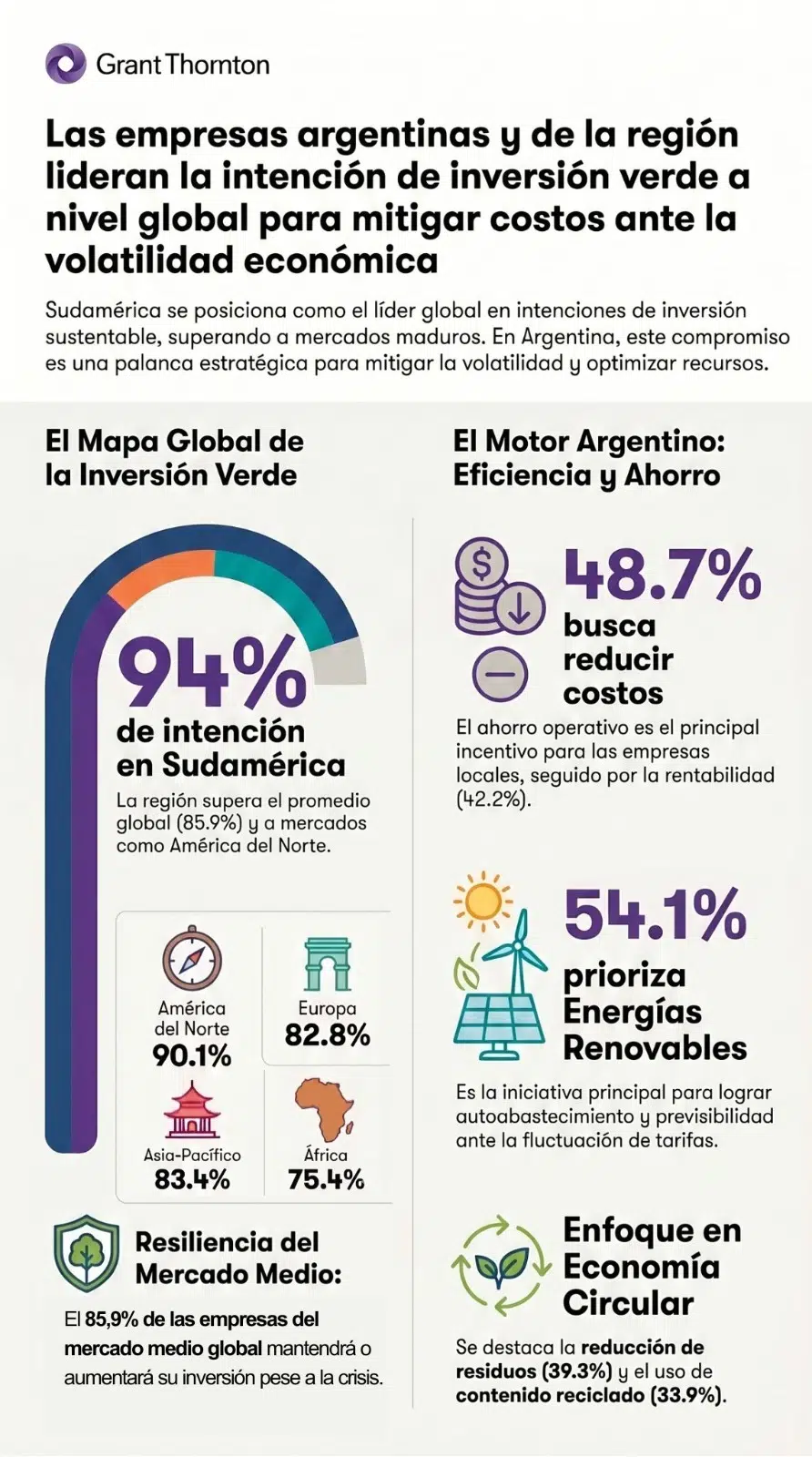
To mitigate costs amid economic volatility, the private sector in South America bets on sustainability as a key strategy. According to the report “Global Intention, Local Reality” by Grant Thornton Argentina, 94% of companies in the region will maintain or increase their green budget, positioning themselves at the global forefront.
Locally, the main driver is efficiency: 48.7% seek cost reduction and 54.1% prioritize renewable energies to safeguard their operations.
Globally, 85.9% of mid-market companies will maintain their sustainable plans, accelerated by the debate on carbon dependency and energy volatility.
In a complex international scenario, where geopolitical tensions in the Middle East and the disruption of oil flows in the Strait of Hormuz accelerate the debate on carbon dependency and price volatility, global mid-market companies are not backing down. According to the latest international report by Grant Thornton Argentina, titled “Global Intention, Local Reality,” 85.9% of global corporate leaders state they will continue to invest heavily in sustainability.
However, the study shows that sustainability is not a universal language. Although the ambition to scale policies is shared, the paths, goals, and expected returns are deeply conditioned by the macroeconomic realities of each region.
In this global map, South America positions itself at the forefront of investment intentions with a strong 94.0%, surpassing mature markets like North America 90.1% and Europe 82.8%.
The focus in Argentina and the region: resilience and efficiency
Unlike other economies, the sustainability engine in local companies is firmly anchored to resource optimization and commercial competitiveness. For South American leaders, the main objective of these initiatives is cost reduction 48.7%, followed by long-term profitability 42.2% and improvement in export levels 37.2%.
Given the abundance of natural resources and the need to shield against tariff fluctuations, the local strategic agenda focuses on:
-
Renewable energy 54.1%: as a way to achieve self-sufficiency and cost predictability.
-
Waste management and reduction 39.3%: driven by the pressure to halt environmental degradation.
-
Recycled content 33.9%: promoting the real transition to circular economy models.
“In a volatile and uncertain commercial context, we see companies acting with short-term caution but with long-term conviction, building resilience and preparing to meet future demands,” commented Alejandro Chiappe, Partner of Advisory Services at Grant Thornton Argentina, who added: “The rules for companies in Argentina and the region are being redefined, and being prepared to meet future demands is vital to stay in the market, protect income, and obtain a social license to operate. We are already seeing organizations preparing in terms of sustainability to not lose their place in the international market.”
The global contrast: What does the rest of the world prioritize?
The Grant Thornton report allows for a clear snapshot of how the green corporate agenda varies by geography:
-
North America (90.1% investment intention): Considers sustainability as a direct lever for growth and value creation in the short and long term. Balances renewable energy (45.7%) with a strong commitment to diversity and inclusion (42.1%) and the development of new sustainable products (40.8%) to gain pricing power and attract investors.
-
Europe (82.8% investment intention): With a highly mature regulatory environment, companies’ focus is shifting from increasing investment to optimizing and integrating existing initiatives (in line with the European Commission’s Omnibus 2025 package). They mainly seek to turn regulatory compliance into cost savings (39.5%) and access to cheaper financing.
-
Asia-Pacific (83.4% investment intention): Directly links ESG criteria with technological innovation, digitalization for efficiency (37.0%), and preparing their supply chains to boost their export levels (43.6%).
-
Africa (75.4% investment intention): Takes a markedly pragmatic approach focused on basic infrastructure. Its investments focus on the foundations for long-term development: renewable energy (48.5%), waste management (33.0%), and access to clean water (28.4%).
The analysis concludes that the value of sustainability is available to all geographies, but it is unlocked in different ways. For Argentine companies with an export vocation or seeking to integrate into cross-border chains, the great challenge and opportunity lie in adapting their strategies to local realities without neglecting global reporting standards and data traceability. Those organizations that demonstrate progress through auditable data will mitigate operational risks and secure a place in increasingly restrictive and selective international markets.



