



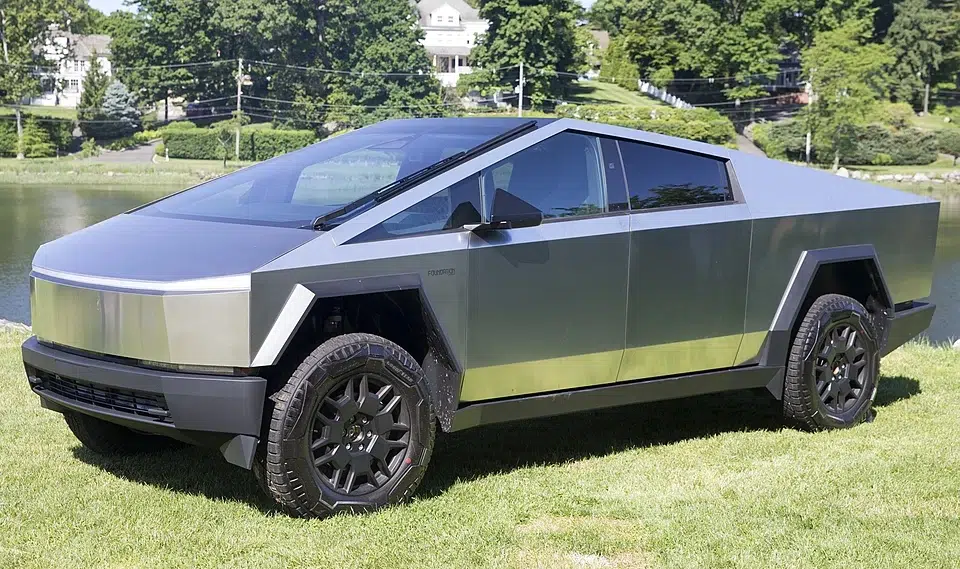
The Tesla Cybertruck, the electric pickup truck designed by Elon Musk, has officially crossed the borders of Argentina. Nearly two years after its debut in the United States, two units of the futuristic model are already circulating on national roads, marking a milestone in the incorporation of high-end electric vehicles into the local market.
The arrival began at the Zona Franca de La Plata, where the vehicles were cleared by customs before being transported on a flatbed truck. Surprised motorists managed to capture images of the vehicle that quickly went viral on social networks. The scene sparked enthusiasm among fans of sustainable mobility and automotive technology.
The importation of this model is handled by Black Sapphire S.A., a company led by Malék Fara, known for introducing luxury brands to the country such as Ferrari, Maserati, and Lamborghini. In the electric vehicle field, Fara had already taken a previous step with the arrival of the XEV Yoyo microcar and the powerful GMC Hummer EV. Now he adds to his catalog one of the most talked-about releases from Tesla.
The Cybertruck is presented as a disruptive vehicle not only for its angular design but also for its technology and features. With three available versions in the United States, the model combines luxury, range, and power in a format that aims to redefine the concept of a pickup truck for the 21st century.
A new chapter for sustainable mobility in Argentina
The arrival of the Cybertruck reinforces a growing trend: the incorporation of electric cars in the Argentine market, a challenge marked by infrastructure limitations and the need to reduce polluting gas emissions.
In its Long Range configuration, the pickup offers four-wheel electronic steering, a 6×4 feet cargo bed, electric frunk, and supervised autonomous driving. The All Wheel Drive version adds adaptive air suspension, premium interior, advanced audio system, and 20-inch wheels. Finally, the Cyberbeast positions itself as the most powerful, with three motors, a top speed of 206 km/h, and the ability to power external electric devices thanks to the Powershare system.
In the U.S. market, Cybertruck prices range from USD 69,990 to USD 99,990, depending on the version. In Argentina, the prices have not been confirmed yet, although it is foreseeable that they will exceed those figures due to import taxes and logistical costs.
Beyond the commercial aspect, the arrival of this model raises a key debate: can Argentina consolidate an electric car market in a context of energy transition?
Electric cars in Argentina: challenges and opportunities
The country faces a complex scenario regarding sustainable mobility. While sales of electric and hybrid cars have increased in recent years, they still represent a minimal fraction of the automotive fleet. The lack of fast charging stations and the dependence on fossil fuels in the energy matrix hinder a massive adoption.
However, the incorporation of high-profile models like the Cybertruck can generate a positive impact by highlighting the need for infrastructure and promoting the conversation about sustainability. Moreover, the growing interest in electric vehicles could encourage companies and governments to develop plans for expanding chargers and offering tax benefits for their purchase.
Another key point is local production. Argentina has vast lithium resources in the “lithium triangle” region, shared with Bolivia and Chile, opening the possibility of integrating into the battery value chain. If investment in research and manufacturing is promoted, the country could shift from being just a consumer of imported electric cars to a producer of essential components for sustainable mobility.
The transition to a less polluting vehicle fleet is also an environmental necessity. Transportation accounts for a significant portion of carbon dioxide emissions in the country. Progressively migrating to electric cars would help reduce the urban carbon footprint and improve air quality in large cities.

A highly relevant arrival for electric mobility
The arrival of the Tesla Cybertruck in Argentina symbolizes much more than the landing of a luxury vehicle: it is a sign that electric mobility is advancing, even in markets where challenges are immense. Technological innovation can become an ally of sustainability, provided it is accompanied by public policies and infrastructure that facilitate its development.
In a world seeking alternatives to combustion-based transportation, the image of a Cybertruck traveling Argentine roads is also an invitation to rethink how we move and what future we want for cities and the environment.



