



A new eruption of the Kilauea Volcano triggered an ashfall warning in various communities on the island of Hawaii. The episode occurred during the early morning and generated ash columns that rose more than 7,600 meters high.
Due to the intensity of the volcanic activity, state and federal authorities implemented safety measures to reduce risks to the population.
Among them were partial road closures and restrictions in sectors of the Hawaii Volcanoes National Park.
Additionally, scientific and meteorological organizations issued recommendations to protect health against the dispersion of ash and volcanic fragments.
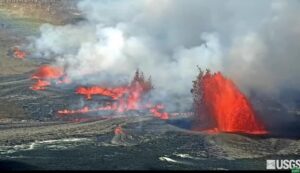
Lava fountains and ash columns after the new eruption
The eruptive event was monitored by the United States Geological Survey and the National Weather Service, which confirmed the magnitude of the phenomenon. According to official reports, the eruption produced powerful lava fountains that exceeded 400 meters in height.
The activity was concentrated in the Halemaʻumaʻu crater, from where lava emerged in intermittent jets. At the same time, ash columns extended towards nearby communities such as Mountain View and Glenwood.
In some areas, accumulations of ash over six millimeters on roofs, vehicles, and roads were recorded. In response to this situation, the National Park Service confirmed the closure of the volcano’s summit and a section of Highway 11.
Health and environmental risks of volcanic ash
The fall of volcanic ash poses a risk to human health and infrastructure. The fine particles suspended in the air can cause eye irritation, respiratory problems, and skin discomfort.
Additionally, larger volcanic fragments can cause damage to roofs, vehicles, and electrical systems. The accumulation of ash can also contaminate water sources and reduce the air quality in areas near the volcano.
Another phenomenon associated with the eruption is the appearance of the so-called “Pele’s hair,” vitreous filaments formed by the rapid solidification of lava. These fragments of volcanic glass can travel long distances with the wind and cause irritation if they come into contact with the skin or eyes.

Characteristics of Kilauea, one of the most active volcanoes on the planet
The Kilauea Volcano is considered one of the most active and monitored volcanoes in the world. It is part of the volcanic system of the island of Hawaii and has frequent eruptions for decades.
Scientific records indicate that it has maintained almost continuous eruptive activity since 1983, making it a natural laboratory for studying volcanic processes. Unlike other explosive volcanoes, Kilauea is characterized by eruptions dominated by relatively fluid basaltic lava flows.
However, in certain episodes, it can also generate ash columns, explosions, and the expulsion of volcanic fragments. Constant monitoring of the volcano allows anticipating changes in activity through the monitoring of earthquakes, ground deformation, and gas emissions.
Recent background and permanent monitoring
The current eruption corresponds to the 43rd episode recorded in Kilauea during modern scientific monitoring. Among the most remembered events is the great eruption of 2018, which caused mass evacuations and the destruction of hundreds of homes.
Subsequently, in 2022, a new eruptive phase forced similar warnings to be issued for ashfall. Due to this recurrent activity, authorities maintain permanent surveillance protocols and early warning systems.
These mechanisms allow for rapid information to the population and reduce the risks associated with volcanic processes. While the eruption continues to be evaluated by scientists and authorities, the evolution of the volcano will determine whether the current restrictions remain or begin to be lifted in the coming days.


