



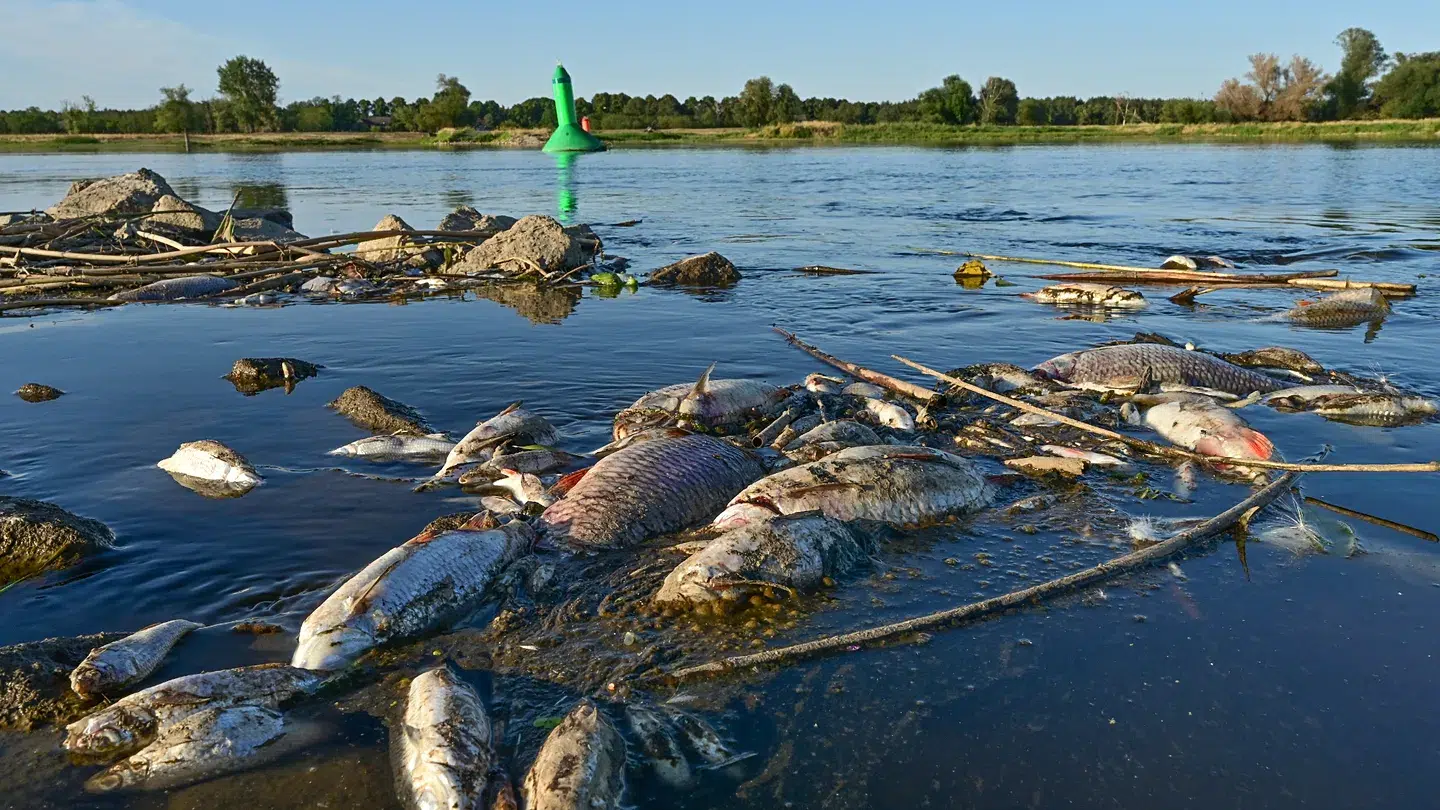
Thousands of fish died in the Pilchowickie Lake, in the southwest of Poland, following the almost total draining of the reservoir coinciding with an extreme heat wave. The combination of renovation works and high temperatures drastically reduced the oxygen available in the water, trapping the fish in shallow, muddy areas.
Residents, fishermen, and environmental organizations denounced the ecological impact and demanded answers, while local authorities investigate the extent of the damage.
Scenes of devastation after the heat wave
Witnesses reported shocking images: fish agonizing for hours and a penetrating smell in the area. Fishing societies attempted to rescue animals and relocate them to other reservoirs, but the magnitude of the mortality exceeded any effort.
A representative of the Grodzkie fishing circle stated: “The image of the damage is terrifying and the smell is difficult to describe. Only the small fish that managed to pass through the diversion gallery grates have survived”.
Risk of contamination in the Bóbr River
The draining of the reservoir dragged sediments accumulated over decades into the Bóbr River, which runs through a landscape park. These sediments may contain toxic compounds and heavy metals, although the exact composition is still under analysis.
The first results from the Regional Inspectorate for Environmental Protection (WIOŚ) show a drastic drop in oxygen levels and deterioration of water parameters below the dam.
Background: the memory of the Oder
The event evokes the environmental tragedy of the Oder River in 2022, when the massive death of fish and aquatic organisms along hundreds of kilometers revealed failures in monitoring and prevention.
The Polish Fishing Association recalled that “all state institutions responsible for inland waters failed.”
Official response and criticism
The company responsible for the reservoir assured that the works were carried out according to procedures and with the corresponding authorizations. It also claimed to have taken measures to limit the impact and announced the conclusion of the dead fish collection campaign.
However, the magnitude of the disaster raises doubts about risk assessment and preparedness for extreme weather events.
Immediate measures
Environmental authorities maintain:
- Continuous monitoring of water quality.
- Cleaning actions in the affected area.
- Recommendations to the population to avoid contact with the Bóbr River until the situation normalizes.
- Support for residents to analyze the quality of water in private wells.
So far, no protected species have been reported affected, although surveillance remains active.
The massive mortality in Pilchowickie Lake exposes the vulnerability of ecosystems to the combination of human works and extreme climatic phenomena.
The dragging of toxic sediments into the Bóbr River reinforces the need for stronger contingency plans and environmental policies that prioritize biodiversity protection in the context of increasingly frequent heat waves.



