



A trawler linked to illegal fishing from China has once again engaged in suspicious movements on the Argentine Continental Shelf.
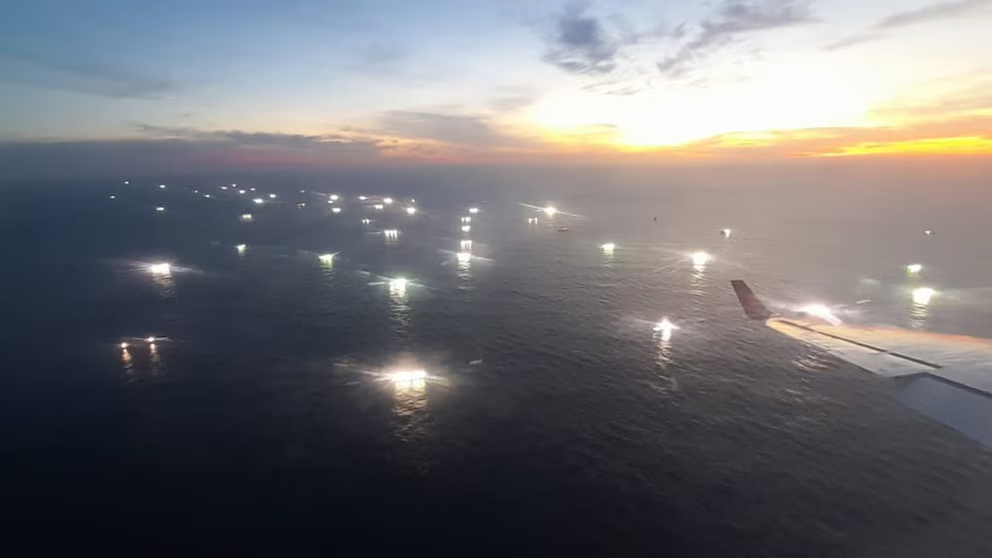
The Naval Prefecture has already detected 148 vessels in transit and estimates that 500 foreign ships will arrive for the next squid season.
The Lu Qing Yuan Yu 205, a Chinese-flagged fishing vessel with a history of illegal fishing in 2016 within the Argentine Sea, has repeated mapping activities this year.
The vessel moved in grids over the Continental Shelf, an atypical behavior for a fishing boat that suggests unauthorized prospecting operations.
Four Chinese vessels under suspicion of illegal fishing
Milko Schvarzman, a marine researcher from the Environmental Policy Circle (CPA), documented that the Lu Qing Yuan Yu 205 did not operate alone.
“This ship, along with others, conducted mapping not only over the Argentine Continental Shelf but also in the waters of the Antarctic,” the expert noted.
The vessels identified conducting these operations are:
- Lu Qing Yuan Yu 205
- Lu Qing Yuan Yu 206
- Long Fa
- Long Teng
All these vessels fly the Chinese flag and exhibit movement patterns incompatible with conventional fishing activities.
The precedent of concerning official response
In May 2023, the then Ministry of Security responded to a request for information on the case.
The official response indicated that the Lu Qing Yuan Yu 205 “conducted its activities on the high seas or open sea (…) without any behaviors suggesting a presumed violation of national fishing regulations.”
The document signed by Alejandro Salesi stated that the vessel “remained operating outside the EEZ, which is why it is not possible to reliably establish the type of operation conducted.”

Enhanced surveillance for the new season
The Naval Prefecture, under the Ministry of Security, has reinforced monitoring of the area in response to the massive arrival of foreign vessels.
“Large fleets sail from various points around the world to the area adjacent to the EEZ to engage in fishing activities,” the institution reported.
Most of these ships come from East Asia, especially from China, South Korea, and Taiwan.
These fleets travel thousands of miles to reach “Mile 201,” the boundary where the high seas begin alongside the Argentine Sea.
The arrival of these foreign vessels represents significant pressure on Argentine fishing resources.
These ships operate right at the edge of the Argentine Sea, capturing species like squid that migrate between the exclusive zone and the high seas.
Intensive fishing in “Mile 201” directly affects the sustainability of fish populations that Argentina manages within its EEZ.
Additionally, activities such as seabed mapping can reveal strategic information about natural resources, underwater topography, and commercial species routes.
Therefore, year after year, the Prefecture implements “periodic and planned patrols” of its surface and aerial resources, in addition to the Coast Guard System, a technological platform developed internally for maritime control and surveillance.

The dilemma of the Continental Shelf
The Argentine Continental Shelf extends beyond the Exclusive Economic Zone (EEZ). A foreign vessel can legally fish there, but without touching or affecting the seabed.
Mapping conducted by vessels from another country constitutes, at the very least, an unfriendly action or potentially hostile. Especially when conducted without prior consultation with Argentine authorities.
The squid season for nationally flagged ships will open on January 2 south of the 49th parallel and on January 12 south of the 44th parallel.
Meanwhile, foreign fleets operate without restrictions in the adjacent areas.
Recent data from the Argentine fishing sector shows positive results: in October, exports reached $223 million.
Thus, it accumulates $1,717 million in ten months, with more than 47,600 tons captured for all species.


