



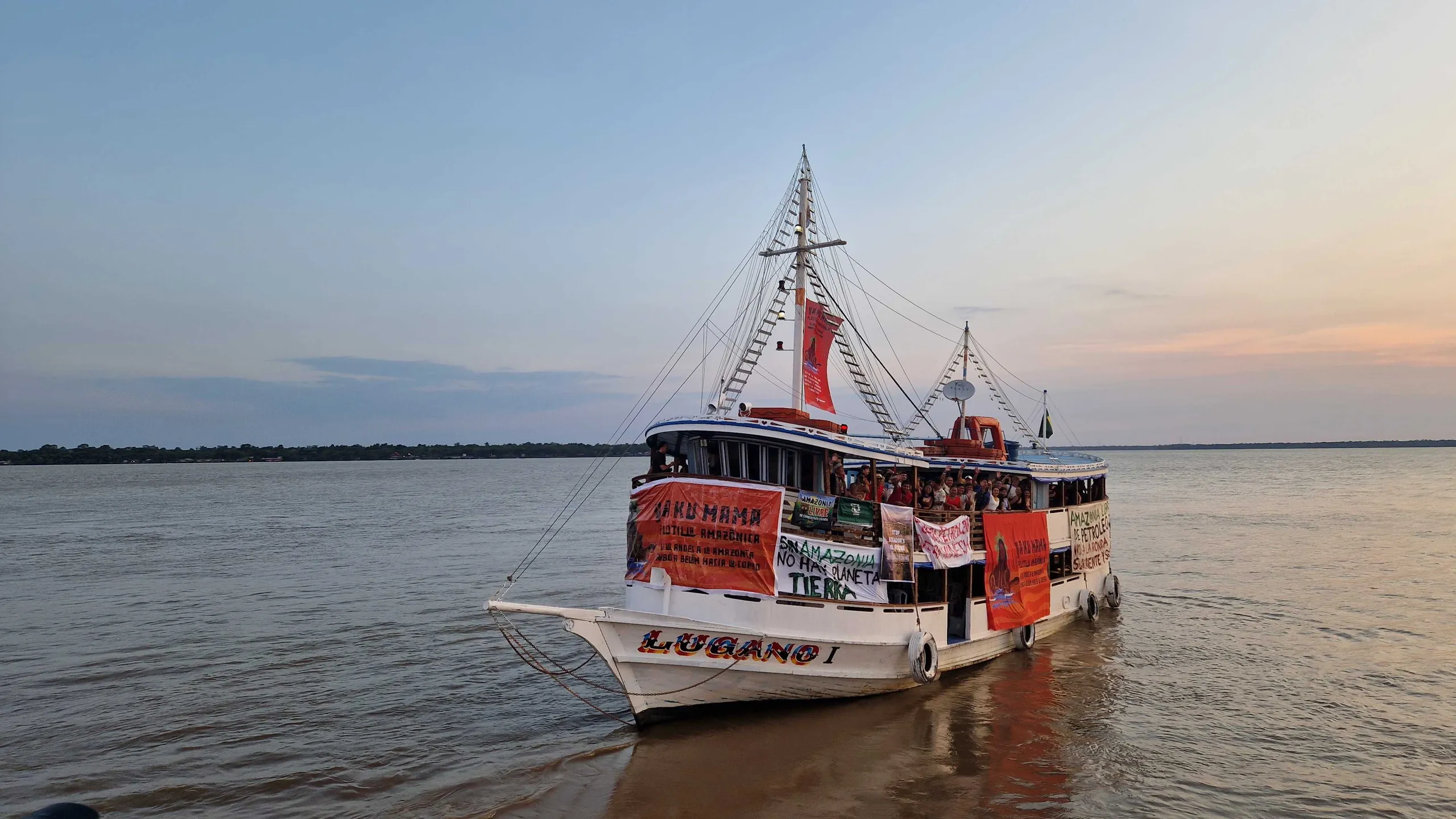
After traveling more than 3,000 kilometers from Ecuador to Brazil, an indigenous flotilla composed of more than 70 Amazonian leaders arrived in Belém to participate in the Conference of the Parties on Climate Change (COP30).
Their journey, marked by encounters and reflections at each stop, carried a powerful message: the energy transition cannot reproduce the same patterns of dispossession as the fossil model.
“We cannot talk about a just energy transition while new sacrifice zones are being opened in our territories,” stated Leo Cerda, Kichwa leader and spokesperson for the flotilla.
Energy transition: between discourse and extractive expansion
Two years after the first global stocktake of the Paris Agreement, which recognized the need to transition away from fossil fuels and triple renewable energy capacity by 2030, commitments still lack concrete actions.
In the Amazon region, the situation is contradictory:
- More oil is being drilled.
- Mining of transition minerals is expanding.
- Renewable megaprojects are imposed without prior consent from communities.
“What we are seeing today is not a transition, but an energy expansion. The discourse changes, but the structure does not,” noted Nadino Calapucha, president of Tu Amazonía.
Ecuador and Brazil: new projects in indigenous territories
In Ecuador, the government announced the opening of two oil rounds in the Amazon starting at the end of 2025: Subandina and Suroriente, which would affect more than 3.5 million hectares of jungle, according to the organization Amazon Frontlines.
Meanwhile, in Brazil, oil exploitation was authorized at the mouth of the Amazon, adding to a study by Earth Insight revealing that 31 million hectares of indigenous territories and local communities overlap with oil and gas blocks.
Insufficient climate commitments
Although at COP28 the need to abandon fossil fuels was recognized, the new Nationally Determined Contributions (NDC) of Amazonian countries still do not include clear plans to reduce oil dependency.
“It has been difficult to include this topic because several economies depend on fossil fuels,” explained Andrés Mogro, from Fundación Avina.
In contrast, the NDCs do mention the expansion of clean energies, although without transforming the underlying model: who decides, who benefits, and who bears the costs.
Renewable energies without consent
The same Earth Insight study warns that 9.8 million hectares of Amazonian indigenous territories overlap with mining concessions.
“Today we see renewable energy projects being installed on indigenous lands without consent, repeating the same patterns of dispossession of the fossil model,” denounced Calapucha.
An example is the case of the Piatúa River in Ecuador, where the community of Santa Clara and the collective Piatua Resiste managed to stop a hydroelectric project in 2019 after demonstrating the violation of their rights and the lack of prior consultation.
Demands of Amazonian leaders at COP30
Amazonian representatives seek to have their demands included in the Just Transition Work Program:
- Clear timelines for the elimination of fossil fuels in a fair and orderly manner.
- Labor planning for fossil sector workers who need to integrate into new industries.
- Direct financing for indigenous communities.
- Recognition of exclusion zones (No Go Zones) in territories where extractive activity is not allowed, especially in areas inhabited by Indigenous Peoples in Isolation and Initial Contact (PIACI).
Between courage and empty discourse
For Calapucha, the challenge of COP30 is clear:
“What is at stake is whether governments will have the courage to end the fossil era and undertake a truly just transition, or if the transition will remain an empty discourse and not a real solution.”
The arrival of the Amazonian leaders’ flotilla in Belém symbolizes the resistance and voice of the Amazonian peoples, who demand that the energy transition is not just a change of source, but a structural transformation that respects rights, territories, and cultures.


