



The recent transplant of a quebracho tree in Villa Allende has sparked a strong controversy between environmental groups and local authorities. The tree, belonging to a native species of dry environments, was removed and relocated in an operation that raised doubts about its long-term viability.
Although it appears stable at first glance, the quebracho tree is in a critical stage of adaptation. Its survival depends on how well it can regenerate roots and withstand the wounds caused during the procedure. This process could take more than a year to show clear results.
It is a tree that, in its natural habitat, survives with very low rainfall, making it resistant to drought. However, the combination of stress from the relocation and drastic changes in soil and water regime can affect its health.
In addition, the techniques applied during pruning and cutting, which, according to specialists, contain errors that could further hinder its recovery. All of this places the specimen in a delicate situation, with an uncertain prognosis.
 Controversy in Córdoba over the relocation of a quebracho tree for a road construction. Photo: Infobae.
The relocation and its ecological impacts
The extraction procedure included the removal of the entire base of the tree, aiming to preserve its original structure as much as possible. However, a large part of its finer roots, essential for absorbing water and nutrients, were lost, and it is not a species with great regenerative capacity.
Despite receiving post-care such as abundant watering and fertilization, these same treatments can become counterproductive. An excess of moisture or nutrients can lead to infections in a still fragile root system.
Furthermore, the incorrect pruning performed during the process left open wounds. If these do not heal properly, they can be the gateway for pests or diseases, further weakening a tree already stressed by the relocation.
The quebracho tree is now in a sort of biological “stand-by”: it survives thanks to the reserves stored in its trunk and thick roots. Its ability to regrow and adapt in the new location will determine if it can survive in the medium term.
The consequences of the relocation for the quebracho tree
Moving a large tree like the quebracho not only implies changing its location but also profoundly altering its physiology. These species are adapted to poor soils and dry climates, so changing their conditions poses a significant ecological and biological risk.
The fine roots, vital for its survival, are often cut during extraction. This hinders the absorption of nutrients and water, which can cause internal collapse if not regenerated quickly.
On the other hand, wounds caused by mechanical tools do not always heal well in this type of tree. The lack of proper healing increases the likelihood of diseases, fungi, or bacteria that can fatally affect it.
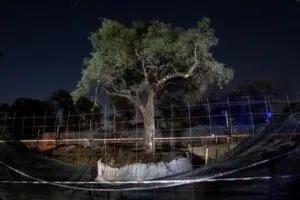 Centennial quebracho tree in Villa Allende
The controversial quebracho tree
Moreover, by placing it in a more humid environment or with inadequate watering, it is exposed to conditions contrary to its natural biology. This can weaken its defenses and cause its few new roots to become ill or die, compromising the entire specimen.
The case of the quebracho tree in Villa Allende opens a debate on how to manage urban plant heritage with ecological sensitivity. Decisions regarding the relocation of native trees should consider scientific criteria, respect for their biology and environmental planning, as what is at stake is not just an individual but the relationship with the environment that sustains it.



