



On February 15, the new Civic Ordinance of the Barcelona City Council came into effect. The text updates the 2006 regulations and reinforces penalties related to the use of public space.
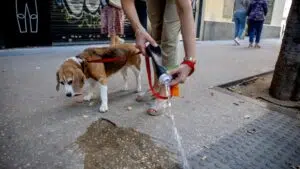
Among the main novelties is the obligation to dilute dog urine with water. Those who do not comply may face fines of up to 300 euros, except in the case of assistance dogs.
During the past month, the city council launched an informative campaign in streets and squares. In this way, it aimed to anticipate the effective application of a regulation that incorporates new aggravating factors and sanctioning typologies.
Additionally, the ordinance states that the dilution must be done only with water. Therefore, the use of soap, bleach, or vinegar is prohibited, as these substances can worsen the environmental impact.

Sanctioned Behaviors and Strengthening Urban Control
The regulation also increases fines for alcohol consumption in public areas. In the presence of minors or in areas with nighttime restrictions, the penalty can reach 1,500 euros. Furthermore, pub crawls are partially banned in acoustically stressed areas. In these cases, penalties can reach 3,000 euros as part of the fight against noise.
Urinating in the street in sensitive areas, such as narrow streets or nightlife zones, may result in fines of up to 750 euros. Additionally, graffiti in unauthorized spaces will require covering cleaning costs.
The display of sexual elements or walking without a shirt outside of beaches or sports practice is also penalized. Fines for exhibitionism or disrespectful behavior can reach 600 euros.
To ensure compliance, the Urban Guard will be able to notify and collect fines immediately from non-residents. This aims to reduce impunity for infractions committed by tourists.
Why Should Urine Be Diluted with Water?
The obligation to dilute urine with water is based on health and urban furniture protection criteria. However, the use of chemical products can generate counterproductive effects.
From an ecological perspective, adding chemicals increases the pollutant load that reaches sewers and watercourses. Consequently, it increases the pressure on treatment systems.
Water, on the other hand, reduces the concentration of ammonia and salts without introducing additional compounds. Therefore, the regulation specifies that dilution must be done exclusively with clean water.
In this way, Barcelona seeks to balance coexistence, hygiene, and environmental sustainability. The measure aims to protect both public space and the urban ecosystems that depend on responsible management.



