



The centenary quebracho tree continues to raise questions about the decision to relocate it.
Today in Villa Allende, the atmosphere was marked by tension and the silence of a police operation.
In a dramatic turn in the dispute over the fate of the historic 284-year-old white centenary quebracho tree, security forces proceeded to evict the environmentalists and neighbors who were maintaining a camp in defense of the tree.
With the activists removed, the imposing crane necessary for the transplant is already positioned, ready to move this living monument that has become the symbol of the struggle between urban development and the preservation of natural heritage.

The day unfolded amidst a secrecy that was only broken by the police action. For weeks now, this white centenary quebracho tree, a specimen of the native species Aspidosperma quebracho-blanco, has been the epicenter of intense conflict.
Its value lies not only in its nearly three centuries of existence, but also in its deep connection to the local biodiversity and environmental memory of the community.
The Municipality of Villa Allende had confirmed its intention to remove it, arguing the need for progress and infrastructure, a decision that immediately raised the alarms of neighbors and organizations.
[caption id="attachment_107954" align="aligncenter" width="533"]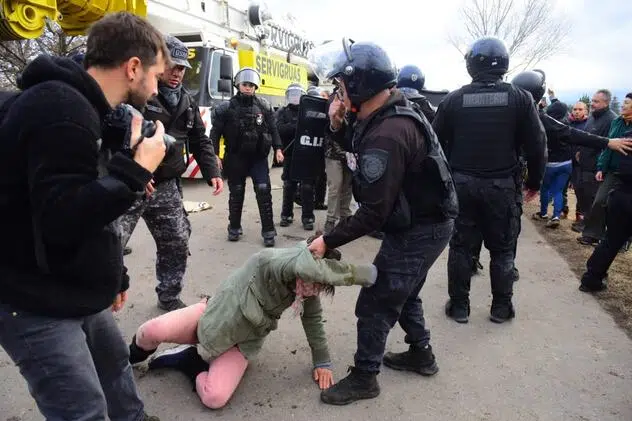 Incidents during the eviction operation of the protesters. Photo: LA VOZ
Silenced resistance: an eviction prior to the relocation
The camp in defense of the quebracho tree, sustained by environmental organizations and environmentally conscious citizens, had become a stronghold of peaceful resistance.
 Statement from crane companies
Days ago, even eight crane companies publicly refused to participate in the relocation operation, citing ethical and environmental consciousness reasons.
Their joint statements highlighted the “atrocity” of moving a specimen of such ecological, scientific, educational, cultural, and historical importance, and questioned the real viability of transplanting a centenary tree.
However, the Municipality’s firmness in proceeding with the relocation seems to have prevailed, at least at this stage.
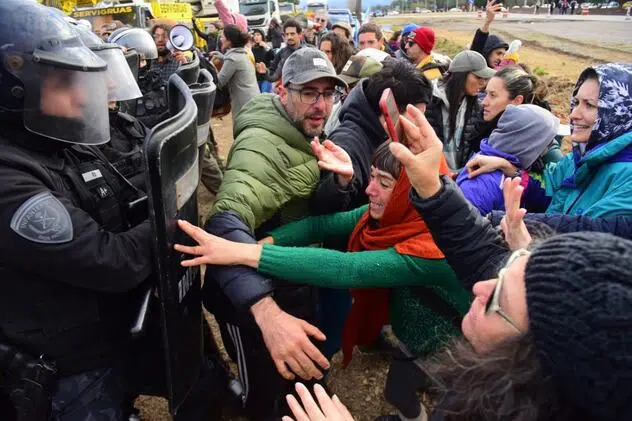 Police eviction of activists and neighbors. Photo LA VOZ
The eviction of the environmentalists in the darkness of the early morning is a clear indication of the determination to proceed with the operation, seeking to avoid further public and media confrontations.
The now visible presence of the crane, a mechanical giant, underscores the imminent movement that experts consider to be of very high risk for the tree’s survival.
Imminent risk for the centenary quebracho tree
As an expert in native trees, I must emphasize the enormous concern generated by the attempt to transplant a 284-year-old white quebracho tree.
Quebracho trees are extremely slow-growing trees with deep and delicate roots. Their survival depends on a complex balance with the soil and the surrounding ecosystem, forged over centuries.
Science is clear on this matter: the transplant of centenary trees, especially of slow-growing species like quebracho, rarely ensures their long-term survival.
The success rate is, unfortunately, very low. The shock of transplantation, the disturbance of the root system, the adaptation to a new soil and microclimate are colossal challenges that few such long-lived specimens manage to overcome.
Beyond its individual value, the removal of a tree of this magnitude implies an irreplaceable loss of ecosystem services – such as habitat provision, microclimatic regulation, and soil conservation – and deep damage to the biocultural memory of the region.
Organizations like Vida Silvestre Argentina and experts from INTA have repeatedly warned about these consequences. Centenary trees are not mere decorative objects; they are an integral part of the natural and genetic heritage of a place, and their loss is permanent.
A worrisome precedent in the urban-environmental debate
The situation in Villa Allende thus becomes a crucial precedent in the debate on urban development and the protection of natural heritage in Argentina.
While the Municipality seeks to carry out its plan, the community and experts continue to raise their voices in search of alternatives that reconcile progress with respect for nature.
Examples from other cities show that the integration of historical trees into urban design is possible and enriches the environment, promoting identity and quality of life.
The image of the crane ready to intervene, after the eviction of those who were defending it, raises a fundamental question: What cost are we willing to pay



