



Seven macaques have continued to live for years in small cages located in a basement in the Saavedra neighborhood, amid a judicial and environmental conflict that keeps their future in suspense.
The case involves the last primate bioterium that operated in Argentina, belonging to the Center for Medical Education and Clinical Research (CEMIC) with the National Scientific and Technical Research Council (Conicet).
Although the establishment stopped conducting experiments with monkeys in 2021, the animals remain housed in conditions that protection organizations consider inadequate.
Moreover, the situation has reopened the debate on the use of primates in scientific research and the fate of the specimens once these programs are concluded. Currently, the macaques remain isolated while possible transfer alternatives to sanctuaries or specialized centers are evaluated.

A judicial conflict that has not yet found a resolution
The bioterium located in Saavedra was for decades the only one authorized in the Autonomous City of Buenos Aires for research with primates. However, after the cessation of scientific activities, a long discussion began about the future of the animals that remained in captivity.
In January 2025, a group of 41 capuchin monkeys managed to be transferred to the Hidden Forest Sanctuary in South Africa, thanks to international funding and private efforts.
However, at least fifteen specimens died beforehand after years of waiting in captivity. Meanwhile, the seven remaining macaques continue to be housed in the building’s basement awaiting a definitive administrative and judicial resolution.
Environmental and protection organizations demand that the animals be transferred to spaces with better living conditions and greater social contact.
The debate on captivity conditions
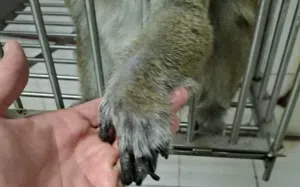
According to complaints from entities related to animal welfare, the macaques live in small cages and are separated from each other, a particularly delicate situation for a species with strong social behavior.
Moreover, the animals remain without access to direct sunlight and with few opportunities for physical movement within the facilities. The case also involves the Specialized Environmental Prosecutor’s Unit (UFEMA), which is analyzing transfer alternatives and the legal conditions of the procedure.
On the other hand, judicial sectors claim that CEMIC itself is working to find a new suitable destination for the remaining specimens. However, various international factors, including geopolitical conflicts and logistical difficulties, have delayed the initially planned transfer options.
Meanwhile, criticisms are increasing regarding the prolonged presence of the animals in spaces designed for research and not for conservation.
What the species is like and why its well-being raises concerns
Crab-eating macaques, also known as Asian macaques, are primates native to Southeast Asia that inhabit tropical forests, mangroves, and coastal areas near water.
They are characterized by their intelligence, adaptability, and complex social relationships within large groups. In the wild, these animals travel long distances daily, establish social hierarchies, and maintain permanent bonds among individuals.
For this reason, animal behavior specialists warn that prolonged isolation and lack of environmental stimulation can cause high levels of stress and physical deterioration.
Additionally, the species has been historically used in biomedical research due to its physiological and cognitive characteristics, a practice currently facing growing ethical criticism in different countries.
As the global debate on the use of primates in laboratories progresses, the case of the Saavedra macaques has revived the discussion in Argentina about animal welfare, conservation, and environmental responsibility.


