



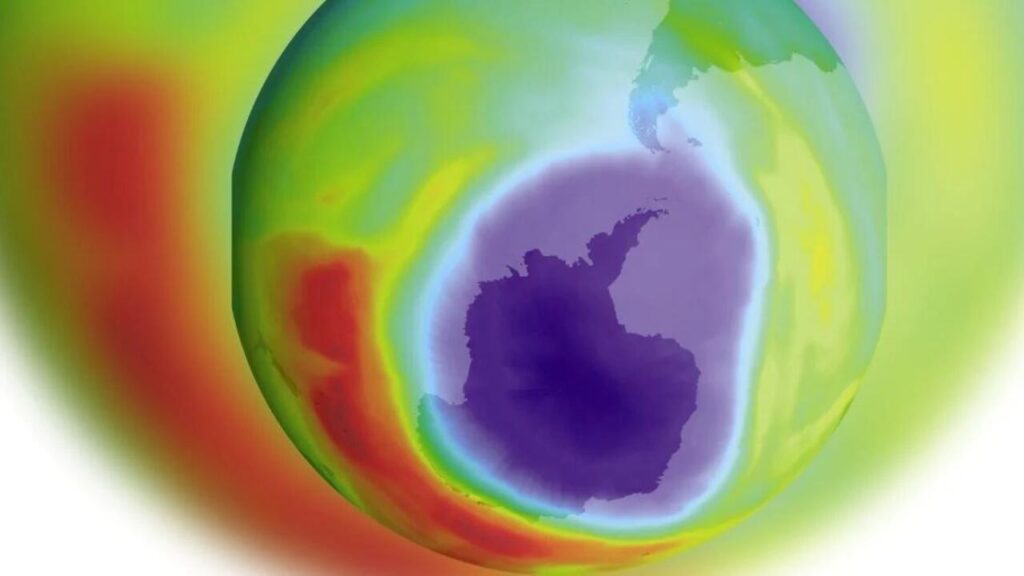
The hole in the ozone layer over Antarctica finished closing this Monday, December 1st, marking the earliest disappearance since 2019.
Additionally, it was the smallest in the last five years, according to Copernicus, the climate monitoring component of the European space program.
For the second consecutive year, the hole showed reduced dimensions compared to the records of the 2020-2023 period.
Therefore, the ozone concentrations were higher, which reinforces hopes for a progressive recovery of this protective band of the atmosphere.
The encouraging signs of ozone hole recovery
“The earliest closure and the relatively small size of this year’s ozone hole is an encouraging sign,” stated Laurence Rouil, director of the Copernicus Atmospheric Monitoring Service (CAMS).
The official highlighted that these data reflect “the steady progress we are observing year by year in the recovery of the ozone layer.”

Rouil attributed these advances to the ban on Ozone Depleting Substances (ODS).
“We should celebrate this progress as a timely reminder of what can be achieved when the international community works together,” emphasized the CAMS director.
The evolution of the ozone hole during 2025
This year, the hole in the ozone layer developed in mid-August.
In early September, it reached its maximum extension of 21.08 million square kilometers, well below the historical record of 26.1 million recorded in 2023.
The surface remained between 15 and 20 million square kilometers during September and October.
It then began to decrease rapidly during the first half of November, until its total disappearance on December 1st.
The Copernicus report indicated that “the ozone hole over Antarctica in 2025 was significantly smaller and lasted less than in the previous five years.”
This behavior represents a concrete advancement in atmospheric protection.
The crucial role of the Montreal Protocol
The ozone layer is a band of gas in the stratosphere that protects the Earth from ultraviolet rays. Without it, the risk of developing skin cancer and various environmental problems increases.
The hole appeared in the 1980s, related to the release of human substances such as:
- Chlorofluorocarbons
- Aerosol compounds
- Industrial refrigerants
These compounds, nonexistent before industrialization, rise to the atmosphere and break ozone molecules, weakening their natural protection.
To reverse the damage, countries approved the Montreal Protocol in September 1987. This agreement banned the production and use of substances affecting the ozone layer.
The Monitoring Service highlighted that “without the Montreal Protocol and its amendments, global ozone levels would have fallen to catastrophic levels.”
The largest and most enduring holes between 2020 and 2023 are a reminder of what could have happened without this international regulation.
Thanks to the global commitment, the ozone layer shows concrete signs of improvement and progressive recovery.


