



A regrettable fact is happening in Tasmania, as the Australian state is losing its ancient forests. This is because a more than 500-year-old eucalyptus stump was cut down by the timber industry, which has authorization to exploit endemic species.
However, what most outraged environmental organizations was that the workers cut down the tree in vain: as it was too large to load onto the truck, they abandoned the trunk at the site.
This place is of utmost importance to the timber industry, as Tasmania represents a small oasis within a country characterized by its deserts. In this sense, its importance lies in the 3.4 million hectares of forests covering half of the island.
Moreover, it is also the Australian state where the most endemic trees are allocated for timber production, with 18.5% of the total exported between the years 2022 and 2023, which is nearly double the national exportation scale.
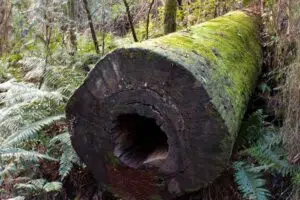 Ancient eucalyptus stump from Tasmania’s ancient forests. Photo: Timber Forestry.
Logging of ancient forests: a practice that is increasingly causing more unrest
According to official data, during 2024, companies felled over 70% of endemic trees and turned them into wood chips, which were later transformed into paper, cardboard, or tissue paper in countries like China and Japan.
But the unrest goes beyond tree felling. This practice led to more than 4,000 people demonstrating in the island’s capital in late March to protest against deforestation, which not only leads to the loss of flora but also of fauna.
The migratory parakeet, considered “critically endangered” since 2015 by the International Union for Conservation of Nature (IUCN), is one of the local species threatened by the timber industry along with the Tasmanian devil and the Australian owl.
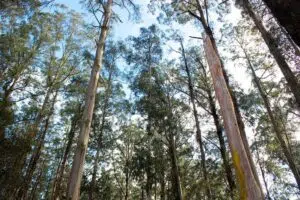 Eucalyptus tree. Photo: Timber Forestry.
The environmental impact of the timber industry in Tasmania
The timber industry in Tasmania represents one of the main threats to the native forests of the island. Intensive logging, especially in temperate rainforest areas and ancient eucalyptus forests, causes severe biodiversity loss and affects critical habitats for endemic species like the Tasmanian devil or the orange-bellied parrot.
In addition to direct deforestation, industrial practices include controlled burning and the conversion of primary forests into plantations, altering the carbon cycle and contributing to greenhouse gas emissions. The disappearance of centuries-old trees affects the natural capture of CO₂.
Forest operations also interfere with watercourses, reducing the quality of freshwater and causing soil erosion. This negatively impacts aquatic ecosystems and the rural communities that depend on these resources.
Environmental organizations warned about the lack of effective protection and the expansion of logging concessions in sensitive areas. The debate between economic development and conservation remains a critical point for the ecological future of Tasmania.



