



The locality of Mar del Tuyú has once again become the center of environmental concern after new storms and a cyclogenesis phenomenon accelerated the advance of the ocean over the Buenos Aires Atlantic coast. In areas where wide beaches predominated decades ago, today the water hits directly against homes and urban constructions.
Additionally, the recent swells exposed foundations and structures that were left practically without natural protection. The scenario has once again raised alarms among residents and authorities of the Partido de la Costa, who observe how the sea constantly modifies the coastal landscape.
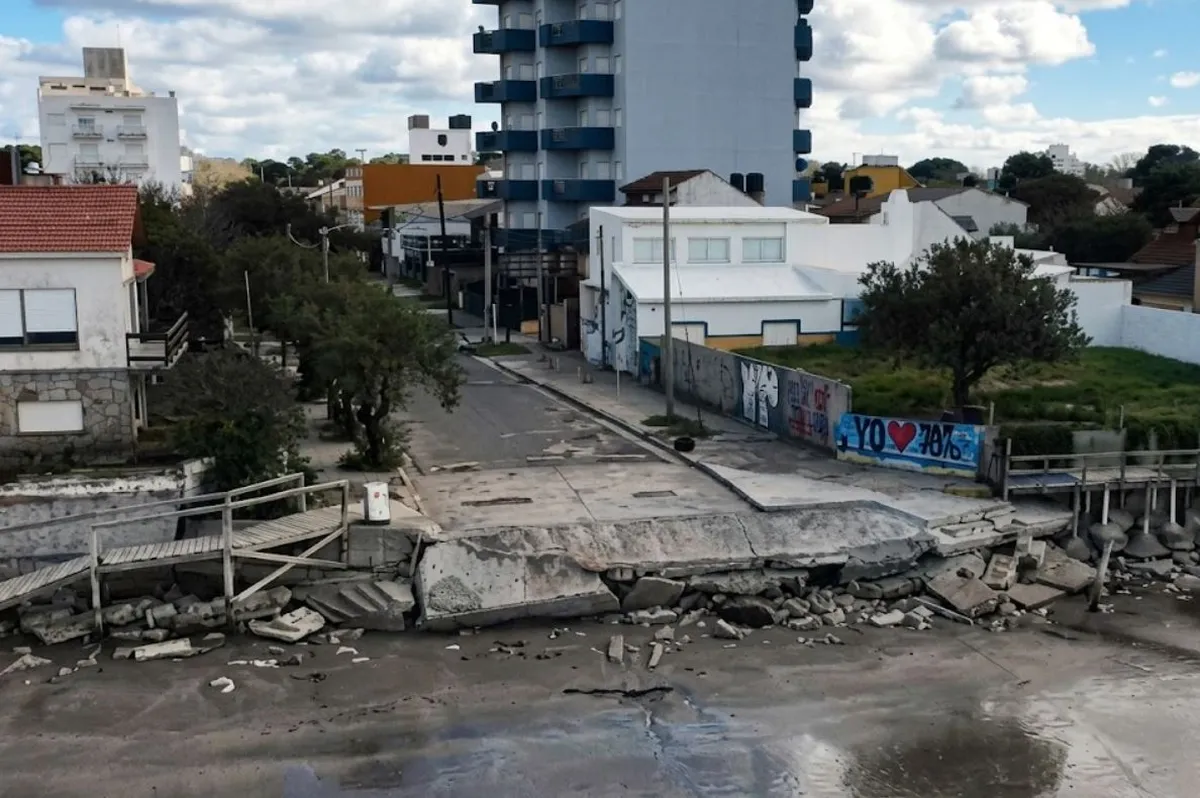
Meanwhile, images recorded in various parts of Mar del Tuyú show the impact of the waves on properties built in areas currently considered of high environmental vulnerability. Some families even had to carry out preventive evacuations due to the proximity of the water to the homes.
Coastal infrastructure under constant threat
The deterioration of the coastline is not recent. However, during the last few weeks the phenomenon has intensified due to extreme weather conditions and the accumulated wear on the Buenos Aires beaches.
Among the most affected areas is the Paseo Stella Maris, where part of the structure was left hanging over the void after the disappearance of large volumes of sand. The erosion eliminated the natural support of the land and exposed areas that were previously used by residents and tourists.
On the other hand, residents recalled the collapse of a house that occurred in July 2021, when a strong southeasterly storm caused the collapse of a construction located in front of the sea. Now, the fear reappears in the face of the persistent advance of the ocean and the fragility of numerous coastal buildings.
Meanwhile, the improvised defenses installed by property owners and some municipal works failed to contain the erosive process. The waves continue to advance over streets, access points, and urbanized areas that lose surface area year after year.
Coastal erosion and the pending challenge in Buenos Aires
The issue has been under analysis for more than three decades in the province of Buenos Aires. In fact, the Law 14.664 promoted the expropriation of more than 300 properties built in environmental risk areas.
However, economic and administrative limitations hindered the effective application of this regulation. Currently, the validity period of the law will expire on July 16, and there are still no concrete definitions about its implementation.
As a result, uncertainty grows among those who live by the sea and observe how erosion rapidly transforms the coastal geography. For many families, the problem has ceased to be a scientific warning and has become a daily threat.

Environmental consequences of the advance of the sea on the Buenos Aires Atlantic coast
The advance of the ocean over the Buenos Aires Atlantic coast generates multiple environmental impacts that affect both ecosystems and human activities. Among the main consequences is the progressive loss of beaches and dunes, fundamental natural barriers to cushion storms and southeasterly winds.
Additionally, the erosion alters coastal habitats where migratory birds, small mammals, and species adapted to dune environments live. The disappearance of these spaces reduces biodiversity and modifies the ecological balance of the region.
On the other hand, coastal retreat increases the vulnerability of cities to extreme weather phenomena linked to climate change. The rise in sea level, combined with more intense storms, accelerates erosive processes and forces a rethink of urban development in areas close to the ocean.
Specialists warn that without comprehensive plans for coastal restoration and land use planning, the deterioration could deepen over the coming decades in various points of the Buenos Aires coast.



