



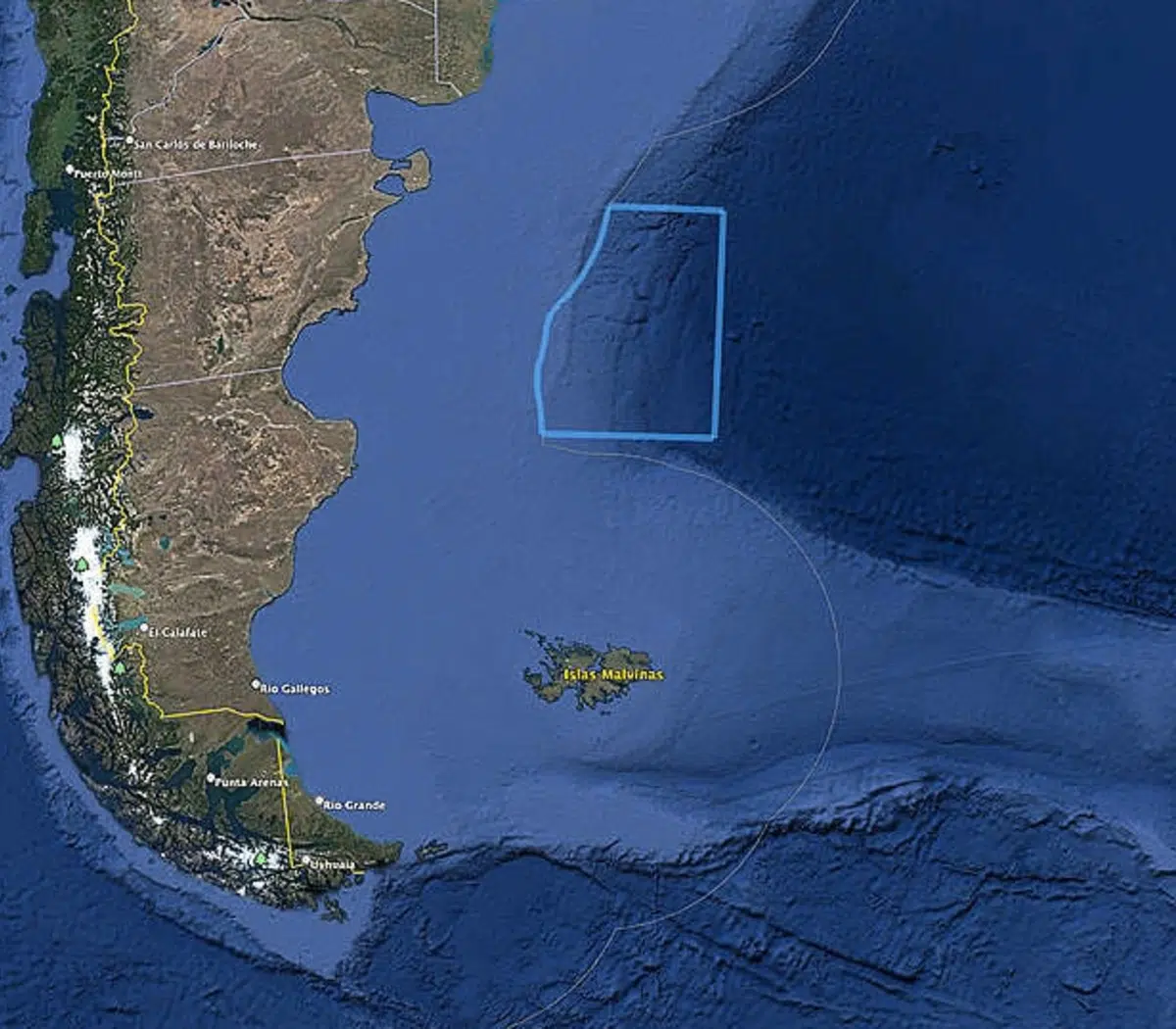
Off the coast of the **Golfo San Jorge**, on the edge of the **Argentine continental shelf**, lies the **Blue Hole**, a unique region due to its [submarine canyons system](https://noticiasambientales.com/ciencia/crean-el-mapa-mas-preciso-de-los-canones-submarinos-antarticos-asi-se-redefine-la-geografia-del-fondo-oceanico/), its **benthic richness**, and its **high biological productivity**.
The **Blue Hole** is frequented by **whales, elephant seals, penguins**, and **species of high commercial value**, but it is also exposed to [unregulated international fishing](https://noticiasambientales.com/medio-ambiente/pesca-ilegal-en-malvinas-el-reclamo-por-el-saqueo-al-ambiente-y-la-soberania-en-aguas-argentinas/).
## A zone outside national jurisdiction but on Argentine territory
Although the Blue Hole is located **outside the exclusive economic zone (EEZ)**, it is part of the **extended continental shelf** recognized by the [UN](https://www.un.org/es/) in response to an Argentine request.
This grants **jurisdiction over the seabed**, but not over the **water column**, where foreign fleets operate with **bottom trawling nets**, one of the most destructive practices for marine ecosystems.
“It’s like seeing a city in the middle of the sea,” recalls **Valeria Falabella**, a marine biologist from **WCS Argentina**, describing the nighttime satellite images that revealed the extent of fishing in the area.
## Environmental impact of unregulated fishing
Trawling in the Blue Hole:
– **Destroys vulnerable ecosystems**, such as reefs and submarine canyons
– **Catches transboundary resources**, such as squid and hake
– **Releases organic carbon** stored in seafloor sediments, contributing to **climate change**
“If there is an oil spill in that area, the productive front is contaminated, impacting the entire trophic chain of the Argentine Sea,” warns Falabella.
## Proposal for a protected benthic area
More than **30 organizations from the Forum for the Conservation of the Patagonian Sea** are promoting the creation of a **148,000 km² benthic natural reserve** that would protect the **seabed**, excluding the water column. This measure would allow:
– **Restricting destructive extractive activities**
– **Preserving unique and highly productive ecosystems**
– **Meeting international conservation commitments**
## Legislative obstacles and political will
Although the project was approved in the **Chamber of Deputies in 2022**, it did not progress in the **Senate**, where the Budget and Finance and Environment and Natural Resources committees did not reach a quorum.
The organizations are in talks with Senator **Edith Terenzi** to **revive the initiative**, although they acknowledge that the current government **prioritizes productive activity over environmental conservation**.
“It is an opportunity to protect a sector of enormous biodiversity. The Senate is committed to debating the law,” states Falabella.
## Fishing monitoring and scientific data
According to estimates by **WCS** based on **Global Fishing Watch** data, the industrial fleet accumulates over **200,000 hours of fishing effort annually** in the Blue Hole.
The **AIS system** allows tracking the position, speed, and heading of vessels, facilitating the calculation of fishing efforts and showing the **intensity of activity in international waters**.
## The Global Oceans Treaty: an international tool to protect the High Seas
While the water column above the Blue Hole is governed by **High Seas freedoms**, it could be managed through the **Global Oceans Treaty**, an international agreement that would enable:
– **Implementing management measures**
– **Establishing marine protected areas**
– **Coordinating multilateral conservation actions**
## WCS: applying science to marine conservation
The **Wildlife Conservation Society (WCS)** is an international organization with **125 years of experience** and presence in **60 countries**.
In Argentina, it has been working for over **60 years**, funding research projects of **20 CONICET scientists** and promoting **environmental management actions based on scientific evidence**.
“For us, the results of the CONICET’s work are very valuable,” concludes Falabella.



