



For decades, the **dry season in the Amazon** has become increasingly arid due to deforestation.
A new study published in *Nature Communications* confirms that **74.5% of the decrease in precipitation** in the region is directly linked to **deforestation**, and that this loss of vegetation cover has also contributed to the [increase in extreme temperatures](https://noticiasambientales.com/medio-ambiente/olas-de-calor-extremas-altas-temperaturas-incendios-y-muertes-marcan-el-inicio-de-agosto-en-varias-partes-del-planeta/).
Forests as water pumps: the role of transpiration in the Amazon’s water cycle
The removal of trees reduces **atmospheric humidity** and alters **regional climate patterns**.
Amazonian trees extract water from the soil and release it into the atmosphere through **transpiration**, a process that contributes to **over 40% of the rainfall** in the basin.
“Each tree functions as a water pump,” explained **Callum Smith**, a researcher at the [University of Leeds](https://www.leeds.ac.uk/). When they are cut down, the **moisture cycle is disrupted**, leading to **reduced precipitation** and **accentuated local heat**.
Extreme heat and climate feedback
Since 1985, the hottest days in the Amazon have **increased by 2°C**, with **16% of this increase attributed to deforestation**.
The study, led by **Marco Franco** and **Luiz Machado** from the University of San Paulo, analyzed 29 areas of [the Amazon basin](https://noticiasambientales.com/medio-ambiente/la-amazonia-se-acerca-a-un-punto-de-inflexion-ecologica-podria-convertirse-en-sabana-antes-de-fin-de-siglo/) between 1985 and 2020.
Using satellite data, they were able to **distinguish the impact of deforestation** from other factors such as **global climate change**. The result: **the most deforested areas experience greater rainfall losses** and **more extreme heat**.
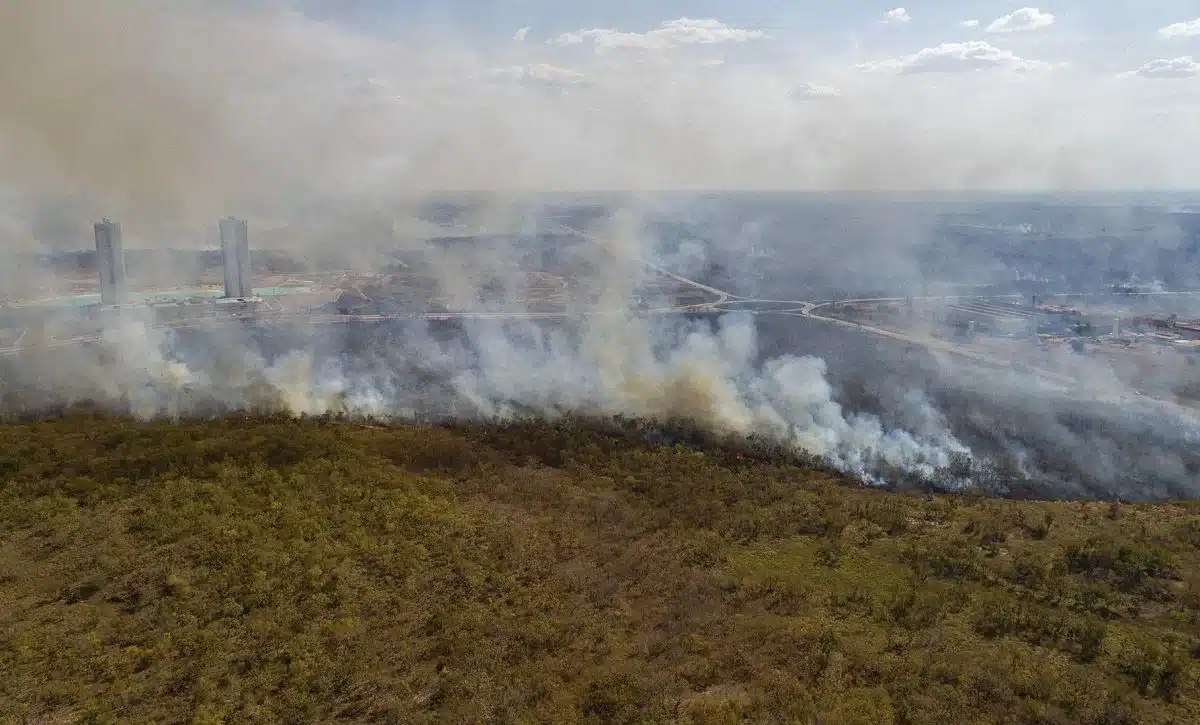 The consequences of fires in the Amazon[/caption>
Fires, droughts, and loss of ecological resilience
The dry forest is more **vulnerable to fire**, which accelerates degradation and perpetuates the feedback cycle.
The decrease in rainfall not only affects biodiversity but also **favors forest fires**, especially in areas subject to **slash-and-burn practices** for agriculture and livestock.
In 2024, more than **16 million hectares** were burned, and in the first half of 2025, **deforestation increased by 27%** compared to the same period the previous year.
Agricultural impact: drought is already affecting crops in adjacent regions
**States like Mato Grosso are facing losses due to lack of rain, with up to 150 consecutive days without precipitation**.
The health of the Amazon is not only vital for wild ecosystems: it also **sustains the necessary rainfall for agricultural production** in nearby regions.
“Farmers are already losing crops due to drought,” warned Franco. The degradation of the biome threatens **food security** and the **economic stability** of large areas of the country.
Science and policy: understanding to act
The study represents progress in quantifying the **impact of deforestation on the Amazon climate**.
Until now, it was known that deforestation affected the climate, but **the precise extent had not been accurately measured**.
This work is a **key step in guiding public policies**, strengthening **tropical forest protection**, and **adapting agriculture to drier scenarios**.



