



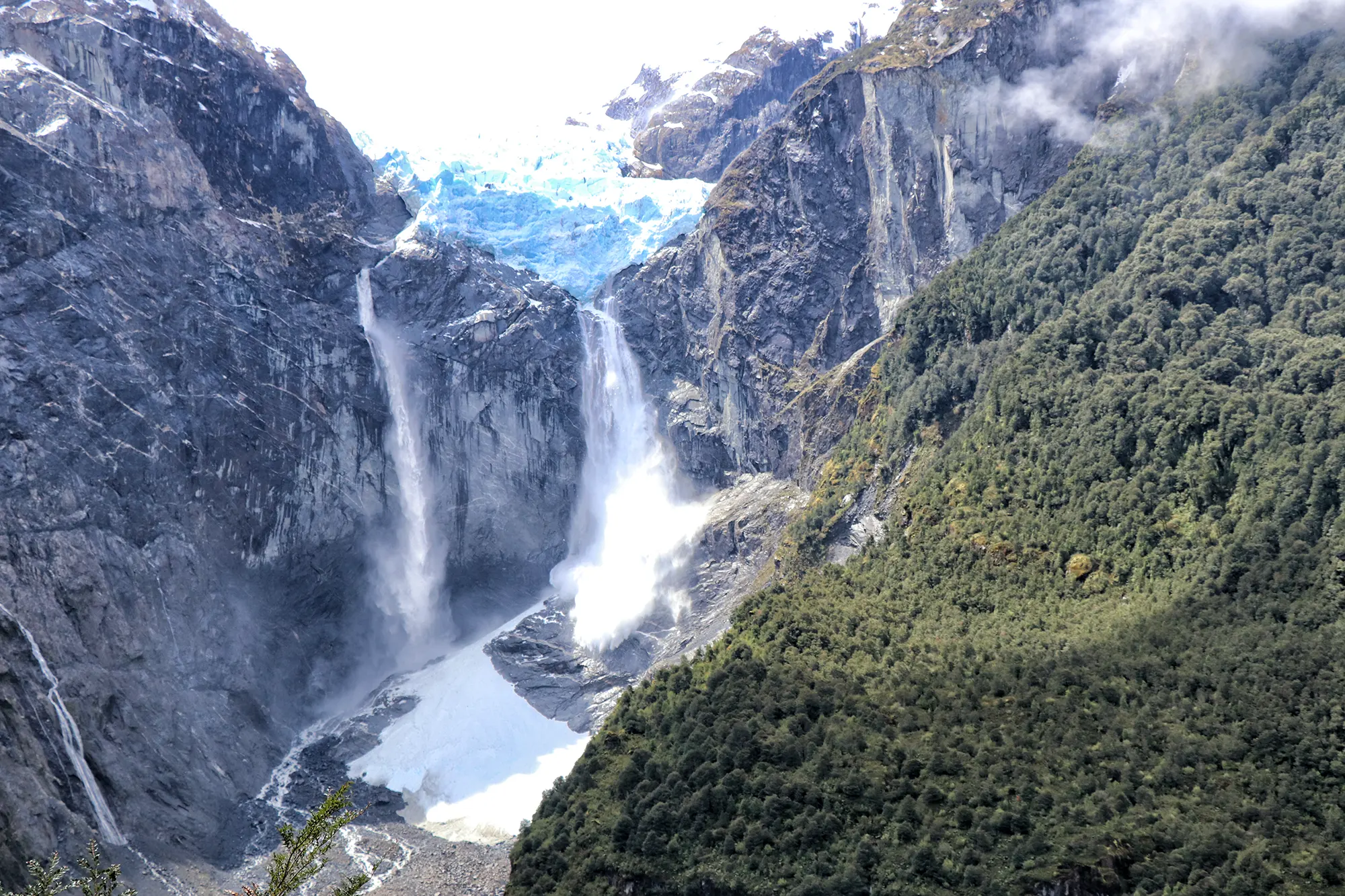
The Chilean Patagonia is a territory that dazzles with its pristine nature and diverse landscapes: turquoise lakes, subantarctic forests, fjords, and glaciers. Among the latter, the hanging glaciers are formations that seem to defy gravity by clinging to steep cliffs.
The most famous is the Hanging Glacier of Queulat National Park, located on the Carretera Austral, near Puyuhuapi. Suspended over dark rock and surrounded by native forest, its spectacular turquoise waterfall falls into the Témpanos lagoon, creating a unique postcard that attracts visitors from all over the world.
The delicate balance that sustains them
The stability of these glaciers depends on a set of factors:
- Friction between ice and rock, which slows down the advance.
- Compaction of accumulated snow, which provides cohesion and acts as an anchor.
- Partial freezing to the bed, generating a cold base that keeps them adhered.
- Terrain irregularities, which act as natural brakes.
- Lateral pressure in narrow valleys, which reinforces stability by leaning on the rock walls.
Despite these mechanisms, hanging glaciers suffer constant detachments. Their permanence depends on the balance between snow accumulation and loss due to ablation or fracture.
Other notable glaciers
Besides Queulat, there are other hanging glaciers in Patagonia:
- Yelcho Glacier (Corcovado National Park): accessible via an easy trek of 2 to 3 hours.
- Balmaceda Glacier (Puerto Natales): visible on cruises through the Última Esperanza fjord.
- Glaciers of Cerro Castillo National Park: accessible via more challenging routes, rewarded with spectacular landscapes.
Glacier vs. ventisquero
Although used as synonyms, there are differences:
- Glacier: mass of ice formed by the accumulation and compaction of snow, which flows by gravity.
- Ventisquero: local term for mountain areas where snow accumulates persistently.
Visiting experience
Queulat National Park offers two trails to appreciate the glacier:
- Trail to the Témpanos lagoon: medium-low difficulty, leads to the shore.
- Trail to the panoramic viewpoint: medium difficulty, ascends through the forest to privileged views.
The park is open from Tuesday to Sunday from 9:00 to 16:30, and tickets can be purchased at pasesparques.cl.
A natural and scientific phenomenon
Hanging glaciers are not only tourist attractions but also subjects of scientific study. Their stability on extreme slopes helps to understand how ice, rock, and climate interact in mountainous regions. Additionally, they are sensitive indicators of climate change, as rising temperatures can alter the delicate balance that sustains them.
The hanging glaciers of Patagonia are a natural phenomenon that combines beauty and mystery. Their stability depends on a delicate balance between ice, rock, and snow, and their contemplation invites reflection on the power of nature and the fragility of these ecosystems in the face of global warming.



