



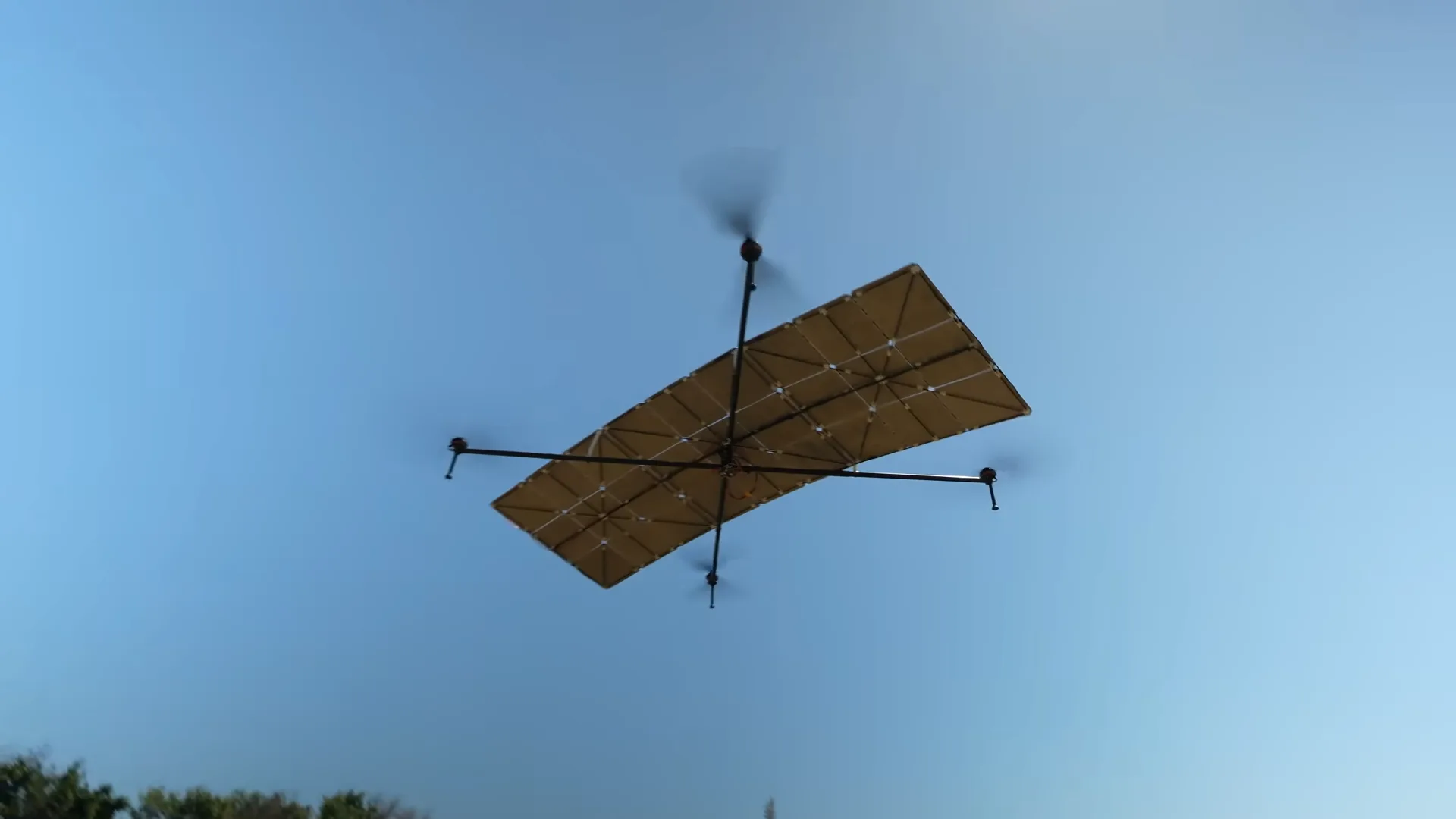
The content creator Luke Máximo Bell developed a functional prototype of a drone powered exclusively by solar energy, an experimental advancement that opens new possibilities for autonomous and sustainable aviation.
The heart of the drone is a brushless motor T-Motor Antigravity MN4004 300kv, designed to offer stable thrust with minimal weight. This type of motor, common in UAVs (unmanned aerial vehicles), is characterized by:
- Ultra-thin design.
- Efficient cooling system.
- Reduced electrical resistance.
All this allows for greater energy efficiency, essential for a drone that relies solely on solar energy.
The structure was assembled by Bell with a focus on minimizing weight and maximizing performance. The motor cables were integrated into the drone’s arms to improve aerodynamics and reduce interference. At the center, the system connects to the flight controller and the ESC T-Motor F60A Mini 8S, recognized for its robustness and ability to handle high currents.
Solar panels integrated into the frame
The most innovative element of the design is on its surface: solar panels integrated directly into the drone’s frame. These were carefully installed to avoid damage to the cells and ensure an even weight distribution.
After initial tests with the tethered drone to calibrate stability, the device managed to maintain almost silent hovering, demonstrating the viability of the concept.
Ultralight propellers for greater performance
Bell incorporated T-Motor NS 18×6 ultralight carbon fiber propellers, which offer:
- Weight reduction.
- Scratch resistance and durability in demanding conditions.
- Excellent thrust/power ratio.
This allows for longer and more stable flights, even in outdoor environments.
Test results
During the trials, the motors generated 17 grams of thrust per watt consumed, while the complete drone achieved 0.7 grams per watt.
Although the figure may seem modest, the design proved to be 24 times more efficient than common vertical takeoff configurations.
Potential applications of solar drones
Bell’s innovation is not just a YouTube experiment. Similar projects are already being explored in research and tech companies, such as the former Facebook’s (Meta) Aquila or European startups working on solar drones for telecommunications.
Among the most promising applications:
- Uninterrupted forest fire monitoring.
- Precision agriculture without frequent recharges.
- Delivery of medicines and supplies in remote areas.
- Continuous environmental surveillance in protected or maritime areas.
A step towards the decarbonization of aviation
Aviation is one of the most challenging sectors to decarbonize. Therefore, technologies like solar drones can play a key role in the energy transition.
If this innovation can be scaled or integrated with smart grids, autonomous aerial vehicles capable of operating for days with minimal environmental impact could be developed.
“It’s not just about a drone. It’s about rethinking how we use energy to fly,” Bell summarizes, demonstrating that solar aviation can start with an experimental prototype and become a real solution.
Luke Máximo Bell’s solar drone is an example of how creativity and technical knowledge can bring sustainable aviation closer to more people. Although still experimental, this prototype paves the way for a future where drones and aerial vehicles can fly without relying on conventional batteries, contributing to cleaner and more efficient aviation.



