



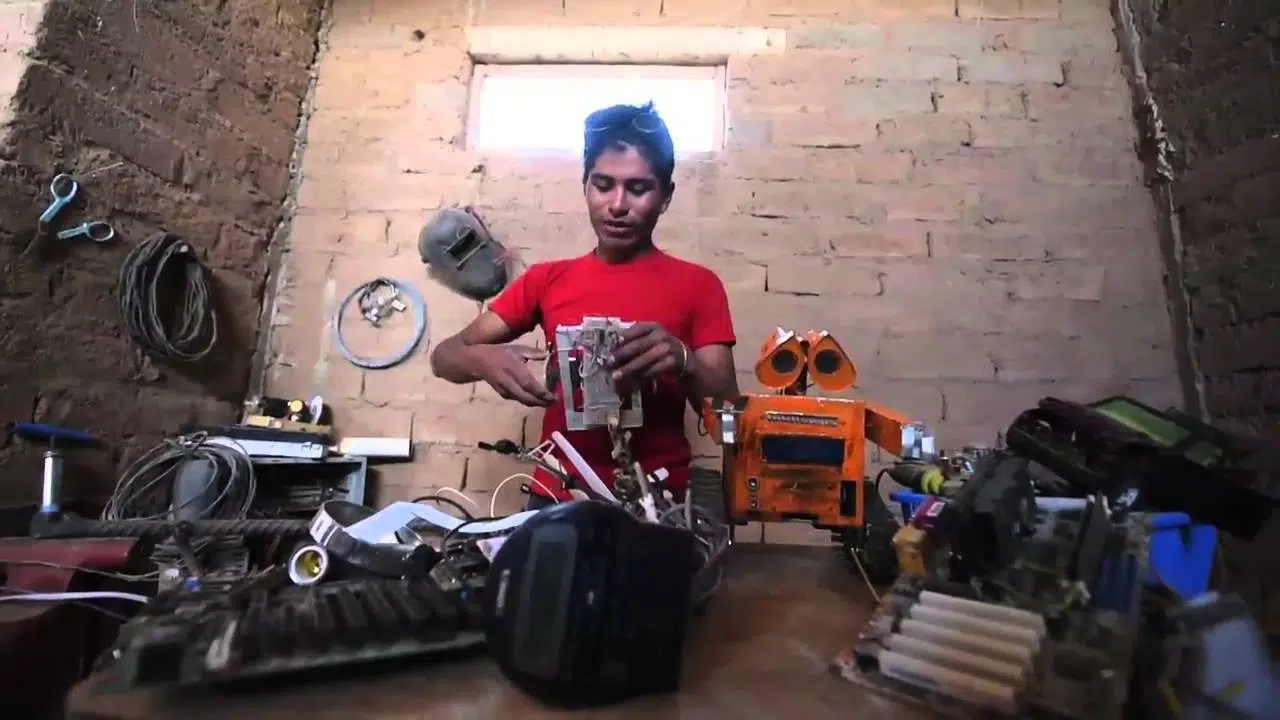
At just 17 years old, the Bolivian Esteban Quispe amazed the world by building a functional replica of Wall-E using recycled material recovered from a landfill. Discarded motors, boards, and cables became the foundation of a robot with tracks and a metal structure, capable of responding to commands sent from a cellphone.
His interest was sparked after watching the Pixar movie in 2008. Years of trials and small projects —like a cart with sequential lights and a three-dimensional LED cube— strengthened his knowledge of electronics and programming, culminating in 2014 with the creation of his recycled robot.
Innovation with Environmental Impact
Esteban’s project is not only an example of creativity but also a warning about the problem of electronic waste. Many of the components he used came from waste discarded without proper treatment, containing hazardous substances like lead and mercury.
According to the Global E-waste Monitor 2024, in 2022, 62 million tons of electronic waste were generated worldwide, of which only 22.3% was formally recycled. Esteban’s initiative demonstrates that a large portion of these materials can be reused before becoming pollution.
Recognition and Academic Future
Esteban’s talent earned him a scholarship to study electromechanics at the Catholic University of La Paz.
His goal is to perfect the robot’s control through voice recognition and continue developing technology with recycled materials, convinced that innovation can arise even with minimal resources.
Recycling in Bolivia: Benefits and Challenges
Bolivia generates more than 1.7 million tons of waste per year, but recycles only a small percentage. Recycling is vital to reduce pollution, decrease waste in open-air dumps, and promote the circular economy.
Environmental and Social Benefits
- Protection of ecosystems: reduces the accumulation of plastics, cardboard, and metals in rivers and streets.
- Support for collectors: provides livelihood to thousands of families engaged in informal collection.
- Resource savings: reduces the extraction of virgin raw materials and industrial energy expenditure.
Main Challenges
- Limited infrastructure: most municipalities operate with unsuitable or open-air dumps.
- Lack of civic culture: scarce waste separation in households and weak enforcement of regulations like the Law 755.
The story of Esteban Quispe is a symbol of how innovation can transform waste into value. His recycled robot not only inspires young people in Latin America but also highlights the urgency of strengthening recycling policies and civic culture in Bolivia.
Creativity, combined with environmental awareness, can become a powerful tool to face the challenges of electronic pollution and move towards a circular economy.



