



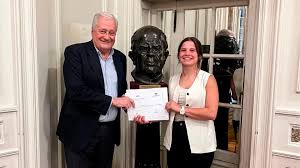
Camila Sol Fernández, 26, has become a reference in biomedical engineering after receiving an award from the Argentine Center of Engineers for her final career project. Her project involved developing biodegradable bone prostheses through 3D printing, a technique that opens up new possibilities in regenerative medicine.
The proposal, emerged from the National University of San Martín (UNSAM), uses biodegradable polymers and compounds that generate mineral layers similar to bone tissue. This allows for the production of customized implants that the body recognizes and colonizes, promoting natural regeneration.
The work was carried out at the Laboratory of Biomaterials, Biomechanics, and Bioinstrumentation (Lab3Bio), where researchers from CONICET, UNSAM, and other public universities converge. This multidisciplinary approach was key to advancing a project that combines science, technology, and social commitment.
Fernández emphasized the importance of public education and scientific collaboration. For her, applied research is a way to give back to the country the opportunities she has received and to contribute to improving quality of life through technological innovation.
## The potential of biomaterials in medicine
Biomaterials used in printing prostheses have the particularity of being biodegradable and bioabsorbable. By degrading in the body, they avoid future surgeries for removal, minimize rejection risks, and stimulate the regeneration of damaged tissue.
Moreover, these implants can incorporate antimicrobial compounds derived from medicinal plants, expanding their ability to prevent infections. This characteristic reinforces the added value of prostheses, by integrating properties that benefit both the patient and the healthcare system.
The use of low-cost 3D printing facilitates the customization of each prosthesis and democratizes access to technologies that were previously inaccessible. In combination with scientific research, this tool is projected as a sustainable solution and efficient in the field of health.
## A path of research, vocation, and commitment
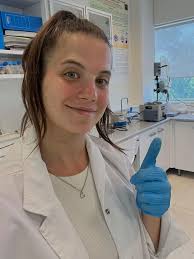
Fernández began her research path thanks to a university scholarship in 2022, motivated by the idea of applying technology in the service of medicine. The possibility of transforming knowledge into concrete solutions led her to delve into the development of biomaterials.
Her work integrates the research lines of two Lab3Bio scientists: the manufacturing of 3D printed prostheses and the study of the antimicrobial power of medicinal plants. The combination of these approaches allowed her to design implants that respond to real clinical needs.
Beyond her thesis, Fernández remains linked to neurosurgery and rehabilitation, providing technical support and collaborating on projects of technology applied to health. Her goal is clear: to improve the quality of life of patients through medical innovation.
Fernández’s experience demonstrates how science, public education, and collaborative work can generate advances with social impact, betting on a more accessible, sustainable, and environmentally respectful medicine.



