



Architecture is once again looking to the natural world for answers to the environmental crisis. In various laboratories and initiatives, biomimicry emerges as an approach capable of transforming the way we build and inhabit the planet.
This perspective envisions cities functioning as ecosystems and buildings acting as living organisms. In Asturias, a research center dedicated to this discipline develops proposals that integrate biological processes with urban design.
The goal is to achieve infrastructures that reduce impacts, regenerate resources, and adapt to the environment with the efficiency characteristic of natural systems.
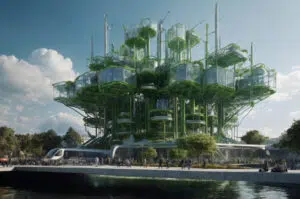
Nature as a model to rethink urban design
Biomimicry is based on studying strategies developed over millions of years by living beings. From these observations, solutions are designed to address current challenges without depleting the environment.
This approach proposes that cities function like forests: spaces where air, water, and energy circulate in closed and regenerative systems. In this framework, architectural design is conceived as an extension of the natural territory.
Buildings cease to be rigid structures and transform into adaptive systems that respond to climatic and social changes. Learning from nature becomes a tool to create more resilient spaces.
Interdisciplinary work is key to this purpose. Biologists, engineers, architects, and environmental specialists collaborate to translate biological processes into urban technologies. The ultimate goal is to develop cities capable of sustaining life without compromising their surrounding ecosystems.
Hidden lessons in organisms and landscapes
The adaptations of plants and animals offer replicable models in the built environment. The way a tree transports water or exchanges nutrients inspires new solutions for resource management. Each biological structure reveals refined mechanisms that can be applied to urban systems.
Understanding natural efficiency also allows for rethinking waste management. The closed cycles present in ecosystems teach how to reduce energy and material losses. Biomimetic architecture seeks to imitate these dynamics to lessen the impact of human activities.
By situating laboratories in natural environments, researchers work surrounded by the processes they aim to replicate. Direct observation of forests, wetlands, and living soils provides valuable information for sustainable design. It is a method that combines science, creativity, and respect for ecological systems.
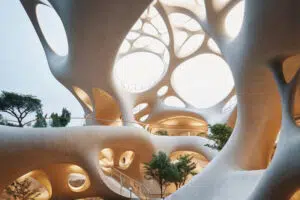
Sponge cities: models inspired by wetlands
Urban flooding drives the search for systems that absorb and regulate water. Wetlands offer a clear example of how to handle large volumes without causing collapses. From this observation, the concept of sponge cities arises.
This type of planning incorporates floodable parks, permeable soils, and green roofs. The goal is to allow water to infiltrate the ground instead of saturating drains. These mechanisms reduce risks while simultaneously improving environmental quality.
The integration of retention ponds and green corridors complements this strategy. By imitating natural hydrological processes, urban areas achieve ecological balance with safer and healthier spaces for the population.
Cities that purify air like forests
Air quality is one of the major challenges in densely populated areas. Forests serve as references by regulating humidity, capturing particles, and generating oxygen. These functions inspire urban designs focused on atmospheric purification.
Vegetative facades, living roofs, and large green areas form the basis of this model. The inclusion of bioactive surfaces allows for continuous pollutant filtration. Buildings cease to be barriers and become allies of the environment.
In this way, cities act as local climate regulators. The transition to infrastructures that breathe helps mitigate the effects of pollution. Human well-being becomes a fundamental indicator for evaluating urban design.
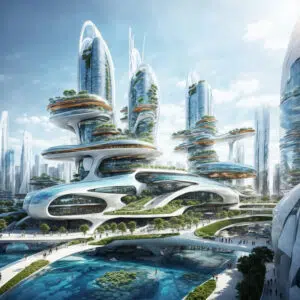
Adaptive buildings that function like living organisms
Biomimicry proposes buildings capable of responding to environmental variations. These designs incorporate systems that capture water, filter air, and manage energy autonomously. Their functioning resembles that of a tree distributing resources according to its needs.
Artificial photosynthetic surfaces allow for converting sunlight into usable energy. These technologies include organisms like microalgae or bacteria capable of purifying the air. Architecture adopts biological processes to enhance its own performance.
The internal structure mimics plant communication networks that distribute nutrients. This approach seeks environmental stability within the building without relying on complex external mechanisms. The selected materials prioritize health, lightness, and efficiency.
Environmental and social benefits of this new approach
Biomimetic architecture offers proposals capable of drastically reducing urban environmental impact. By functioning like living organisms, buildings minimize resource use and optimize their internal management. This translates into less energy consumed and fewer associated emissions.
Systems based on closed cycles reduce waste generation and promote constant reuse. The integration of purifying surfaces contributes to improving air and water quality. Cities become healthier spaces for their inhabitants.
Moreover, these approaches strengthen resilience against extreme climatic phenomena. Sponge cities, adaptive buildings, and regenerative infrastructures reduce vulnerabilities. The population benefits from safer, greener, and more balanced environments.



