



A team from the Nanjing University of Aeronautics and Astronautics has created a floating hydrovoltaic generator (W-DEG) capable of transforming the energy of raindrops into electricity.
This innovation could redefine renewable energy generation in regions with high rainfall and land space limitations, by utilizing water as both a physical support and an electrical component.
How the W-DEG Works
- The device floats on lakes, reservoirs, or coastal areas, without the need for rigid structures or heavy metals.
- When a drop impacts the floating dielectric film, the surface tension of the water and its ions act as charge carriers, generating electricity in a stable manner.
- Each impact can produce peaks of up to 250 volts, comparable to conventional generators.
Professor Wanlin Guo, project leader, highlighted: “By allowing water to perform both structural and electrical functions, we have unlocked a new pathway for electricity generation from raindrops, which is lightweight, cost-effective, and scalable”.
System Advantages
- Weight reduction: up to 80% less than traditional generators.
- Lower costs: nearly half compared to conventional systems.
- Durability: withstands variations in temperature, salinity, and biological contaminants.
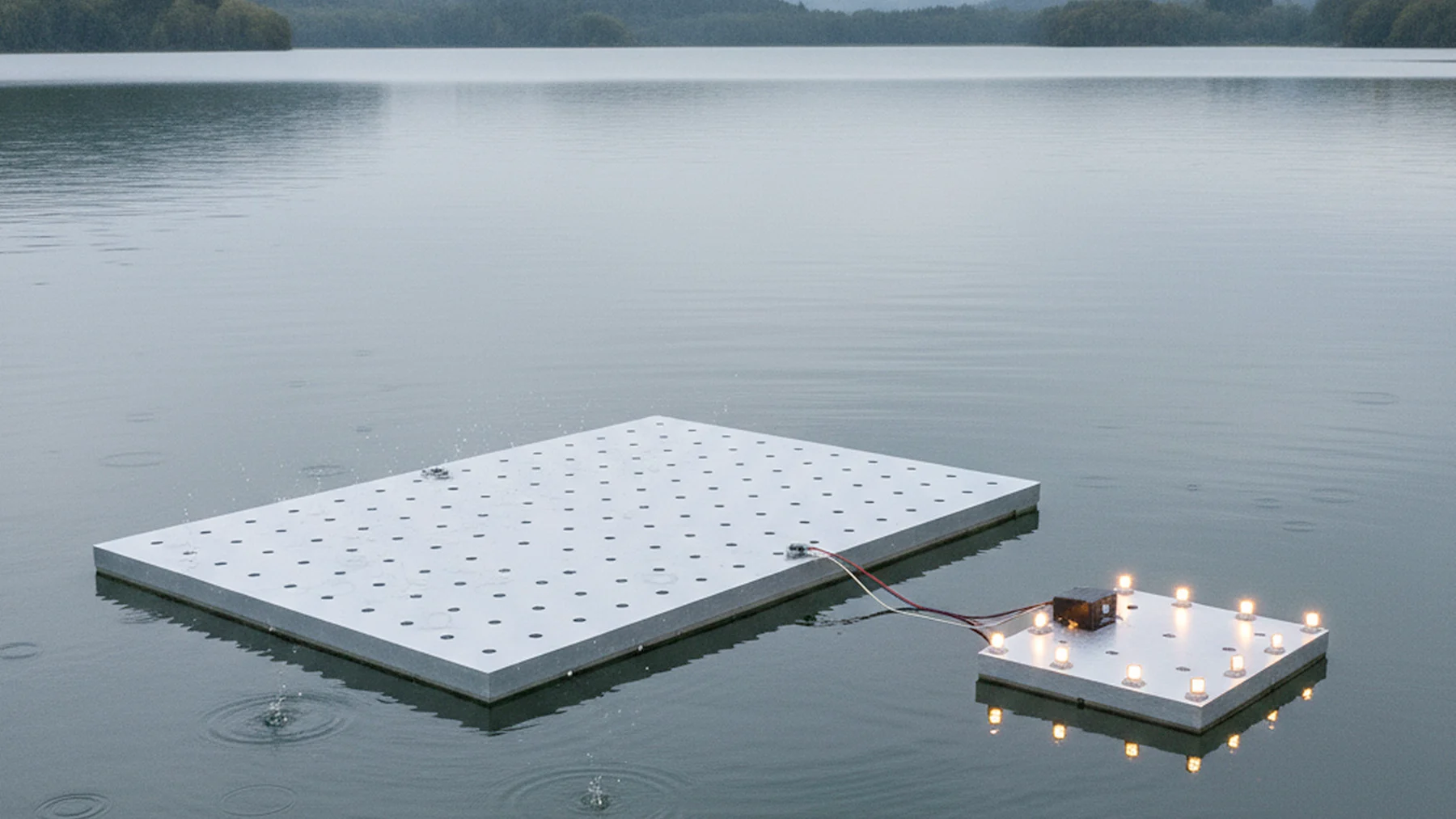
- Self-regulation: incorporates drainage micro-holes that prevent water accumulation and ensure consistent performance even in heavy rains.
Testing and Applications
The 0.3 m² prototype managed to simultaneously power 50 LEDs and charge capacitors in minutes, demonstrating its potential for low-power devices. Future applications include:
- Installation in bodies of water to obtain energy without occupying land.
- Integration into environmental monitoring systems (water quality, salinity, pollution).
- Use as a distributed energy source in regions with frequent rain, supporting local grids or isolated systems.
A Complement to Other Renewables
Professor Guo emphasized that this advancement opens the door to soil-free hydrovoltaic systems, capable of complementing technologies like solar and wind. Demonstrating a durable and scalable prototype represents a key step towards the practical application of this technology in the transition to cleaner and more sustainable sources.
The floating hydrovoltaic generator from Nanjing shows that energy can be found in the most everyday things: a simple raindrop. Its lightweight, economical, and adaptable design makes it a promising alternative to diversify the energy matrix and better utilize water resources in a world seeking to reduce its dependence on fossil fuels.



