



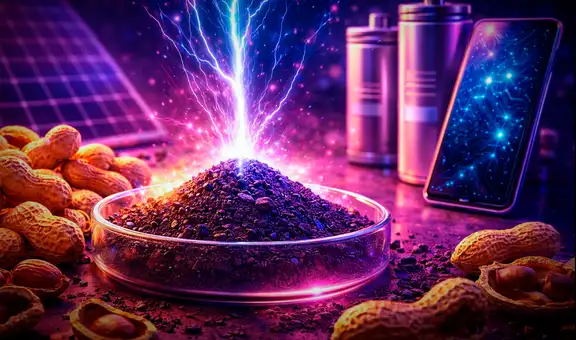
A group of scientists from the University of New South Wales (Australia) managed to transform simple peanut shells into a high-performance material for lithium-ion batteries, and they did it in just 10 minutes.
The process involves subjecting the shells to controlled thermal treatment, converting them into a porous carbon structure with ideal properties to enhance electrical conductivity and optimize energy storage.
This breakthrough, published in the Journal of Energy Storage, could revolutionize mobile phone charging, increase device autonomy, and reduce environmental impact by utilizing an agricultural waste as raw material.
Properties of the new material
The porous carbon obtained from peanut shells presents significant advantages:
- Higher electrical conductivity, allowing for faster charging.
- Optimization of energy storage, increasing device autonomy.
- Partial replacement of traditional graphite, reducing dependence on synthetic or scarce materials.
- Renewable and economical source, adding value to agricultural waste.
Potential applications
The biomass-derived material could be applied in multiple sectors:
- More durable cell phones: greater autonomy without increasing device size.
- Improved fast charging: less time plugged in thanks to better conductivity.
- Electric cars: cost reduction in batteries and greater sustainability.
- Renewable energy storage: more efficient solar and wind systems.
- Portable devices: laptops, tablets, and wearables with better energy performance.
- Agricultural circular economy: transforming waste into high-value industrial products.
Lithium-ion batteries: technological context
Lithium-ion (Li-ion) batteries are essential for mobile devices, electric vehicles, and energy storage systems. They operate by moving lithium ions between an anode (usually graphite) and a cathode (metal oxides), through an electrolyte.
Main advantages
- High energy density: up to 250 Wh/kg.
- Long lifespan: between 1200 and 3000 charge cycles.
- Low self-discharge: they lose energy slowly when not in use.
- No memory effect: they do not require complete discharge before recharging.
Common types
- LCO (Lithium cobalt oxide).
- NMC (Nickel, manganese, cobalt).
- LFP (Lithium iron phosphate).
Challenges and the use of peanut shells
Although highly efficient, lithium-ion batteries are sensitive to extreme temperatures and can heat up or catch fire if misused. Therefore, battery management systems (BMS) are crucial to control temperature and balance the charge.
The transformation of peanut shells into battery materials represents an advance in the circular economy and sustainable technology. This development could not only improve the autonomy and charging speed of electronic devices but also reduce environmental impact and give new value to agricultural waste.



