



On the coast of **Chubut**, [the **Patagonia Azul** project](https://noticiasambientales.com/turismo/patagonia-azul-un-santuario-de-biodiversidad-en-las-costas-de-chubut/) joins a global scientific network that turns **casual photos into key data for marine conservation**. The tool is called **HappyWhale**, a digital platform that allows anyone to **register, upload images of cetaceans**, and contribute to the **species monitoring** such as humpback whales, southern right whales, and dolphins.
## A living and open database
Each image acts as a fingerprint that helps identify individuals and enrich global knowledge.
HappyWhale was born as a system to **identify [humpback whales](https://noticiasambientales.com/animales/avistamiento-record-rio-de-janeiro-celebra-el-regreso-masivo-de-ballenas-jorobadas-a-sus-costas/)** from photographs, but today it expands to **new species** and regions.
Images of the **fluke, dorsal fin, or head** of the whales allow for the unique and precise identification of individuals, creating a **dynamic database** that is updated with each match.
“Many eyes, or cameras, see more than one,” summarizes **Lucas Beltramino**, a biologist from the Patagonia Azul Provincial Park.
## Patagonia Azul: local science with global impact
The regional catalog is enhanced by integrating with HappyWhale and revealing **unknown migratory routes**.
The Patagonia Azul Park maintains its **own record of sightings**, which includes **frequency, permanence, and interactions** of individuals. By integrating with HappyWhale, this data is **connected with records from other regions**, allowing to **discover previously invisible migratory routes**.
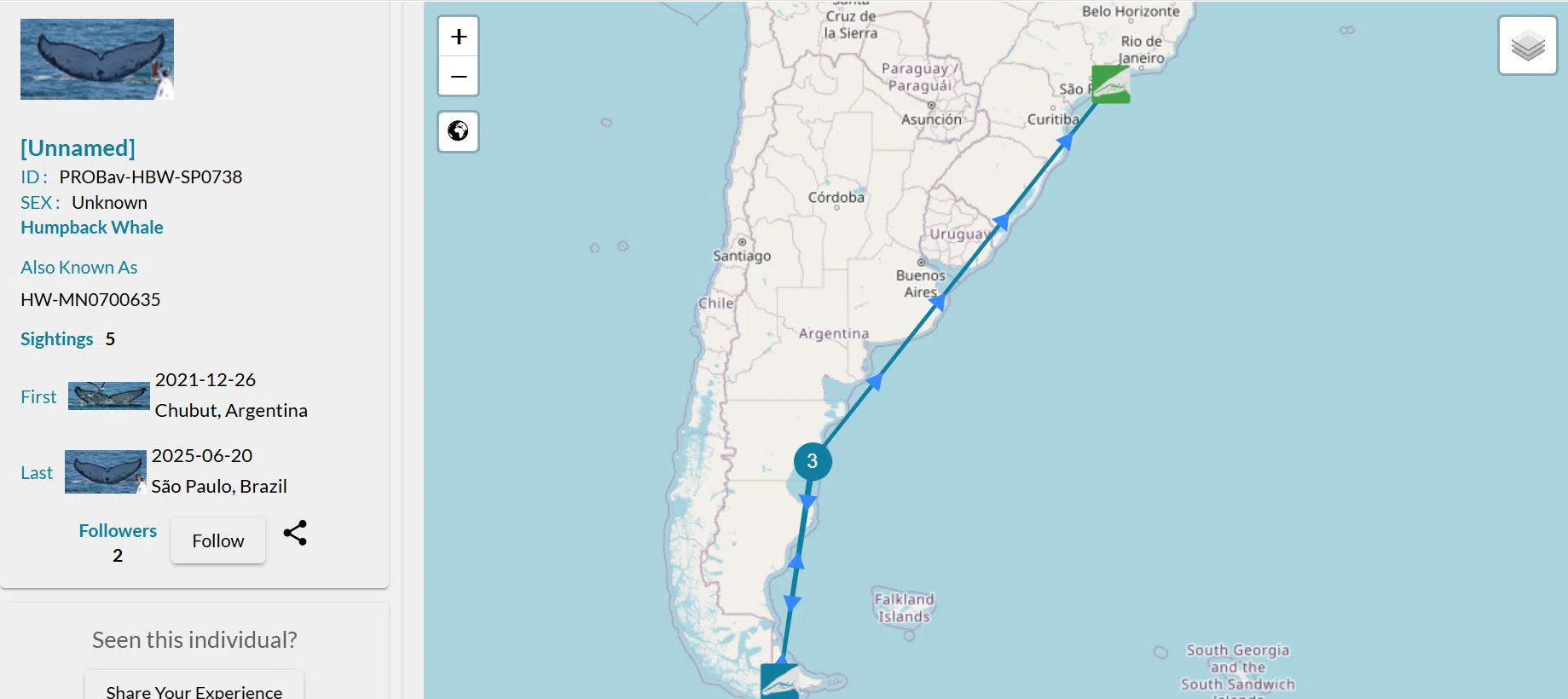
An emblematic case demonstrates this: a whale registered in Chubut was photographed later in the **Beagle Channel** and later in **Brazil**, confirming a **previously unknown migratory route**. “Today we know that there is a route for the humpbacks that was unknown five years ago,” says Beltramino.
## Citizen science: how to participate from anywhere
Uploading a photo can turn anyone into part of a **marine conservation network**.
The process is simple: go to [happywhale.com](https://happywhale.com/home), create a user, and **upload photos with the date and location of the sighting**. If the image allows the identification of an individual, the platform **returns the information to the observer** and **updates the global database**.
“A holiday photo can become valuable data for science,” highlights Beltramino.
## A network of memories, routes, and environmental awareness
**Citizen contributions strengthen conservation** and promote more conscious links with the natural environment.
Beyond the scientific data, HappyWhale **opens the door to new forms of environmental awareness**. Curiosity about uploading a photo can lead to an **interest in the species’ situation** and to **more informed decisions** on how to interact with the sea and its inhabitants.
“We all build knowledge together. An image can be a memory, but also a connection between two sites for a species,” concludes Beltramino.



