



Más de 2.200 millones de personas en el mundo lack guaranteed access to safe drinking water. This problem is not limited to poor regions: even in countries with advanced infrastructures, millions depend on fragile systems and vulnerable to droughts, pollution, or supply failures.
Faced with the depletion of rivers, reservoirs, and aquifers, a group of engineers from MIT decided to look towards the atmosphere, where there is an immense resource: water vapor.
A panel that captures water from the air
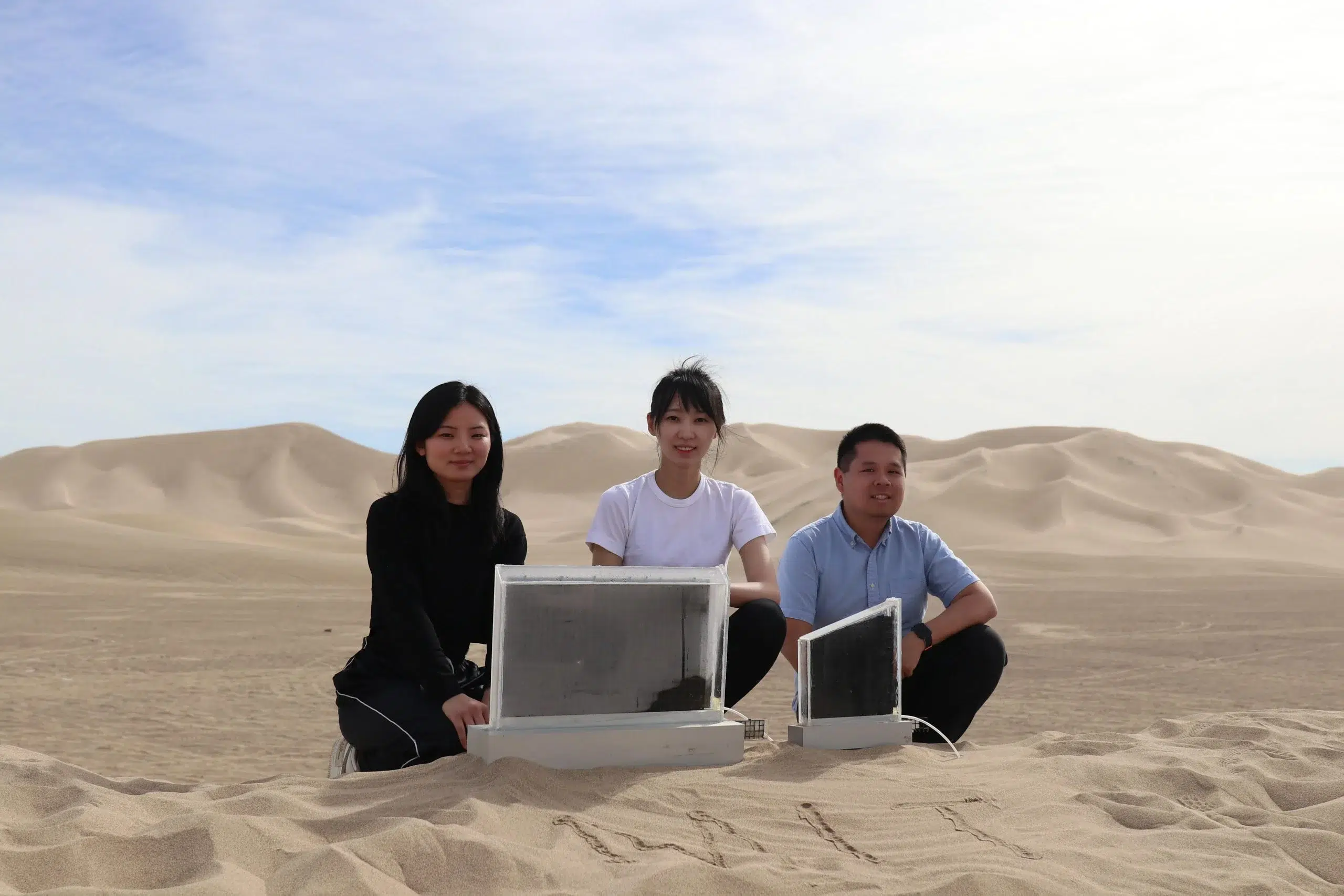
The developed device is the size of a domestic window and is based on a highly absorbent hydrogel housed in a glass chamber with an exterior coating to promote condensation. Its appearance resembles a dark bubble wrap, where each dome maximizes contact with the air.
- At night, the hydrogel absorbs water vapor and expands.
- During the day, ambient heat releases that vapor, which condenses on the cooler glass.
- The liquid water descends by gravity and is collected in simple tubes.
It requires no motors, pumps, or electricity: it operates solely by the natural dynamics of materials and heat.
Testing in extreme conditions
The system was installed for a week in Death Valley, one of the driest places on the continent. Despite low humidity (around 21%), extreme temperatures, and intense radiation, the device produced between 57 and 161.5 ml of potable water daily. Although the figure seems small, it surpasses many existing passive systems and competes with active designs that require external energy.
The key lies in scalability: several panels in parallel, occupying little space and placed vertically, could cover the basic needs of a household.
Innovation against saline contamination
One of the historical problems of hydrogel-based systems is the leakage of salts, such as lithium chloride, which contaminate the collected water. MIT solved this challenge by incorporating glycerol into the hydrogel:
- Stabilizes the salt within the material.
- Prevents its crystallization.
- Drastically reduces its leakage.
- The hydrogel lacks nanometric pores, further limiting the release of salts.
The result is water with salt levels well below potability limits, without the need for filters or additional processes.
Potential and applications
The system is conceived as a viable solution for regions with limited resources, where installing solar panels is difficult and maintenance must be minimal. Its possible applications include:
- Panels integrated into homes in arid areas.
- Emergency systems in extreme droughts.
- Basic supply in refugee camps.
- Reduction of bottled water transport.
- Complement to local water infrastructures.
Future of research
The team plans to optimize materials, improve geometries, and test multipanel configurations in different climates. They are also exploring the use of metamaterials, capable of amplifying useful vibration or improving resistance without increasing mass or material consumption.
The MIT device is not a miraculous solution, but it is a different way of thinking about water access: harnessing an omnipresent and hitherto underutilized resource. Air is everywhere, so is humidity. Sometimes, the most transformative solutions do not come from large infrastructures, but from smart materials, well designed and placed where they are most needed.



