



Scientists from Stanford and Northwestern universities developed a biological system capable of transforming CO₂ into valuable chemicals.
The breakthrough, published in Nature Chemical Engineering, would allow this greenhouse gas to be converted into raw material for the industry.
The method, called ReForm, uses five steps to process carbon dioxide.
The researchers applied genetic engineering to natural molecules to optimize the capture and transformation of CO₂ into useful compounds.
Transforming CO₂, an urgent challenge for the planet
Currently, high levels of atmospheric CO₂ are one of the main threats to climate change and the environment.
In the last five decades, carbon dioxide levels in the environment have increased by more than 30%, according to measurements from the LOAA observatory in Hawaii.
Therefore, transforming the industry to reduce or eliminate its CO₂ footprint is an essential challenge the world faces today.

“If we want to tackle this global challenge, we urgently need new pathways for manufacturing products with negative carbon emissions,” explained Ashty Karim, a researcher at Northwestern and co-director of the study.
Today, the speed of climate change is more concerning than absolute levels, with CO₂ as the main culprit.
Facing this problem is the ReForm system, which combines with other existing technologies to create a closed industrial cycle.
How ReForm works
The ReForm system first converts CO₂ into formate (HCO₂⁻), an organic molecule that few organisms efficiently utilize.
Scientists extracted enzymes from these bacteria to use them outside of the microorganisms.
“It’s like opening the hood of a car and removing the engine,” said Michael Jewett, co-director from Stanford.
“Then, we can use that engine for anything else, free from the car’s limitations,” he added.
The process transforms formate into acetyl-CoA and then into malate, a compound usable by the chemical industry. Applications include:
- Production of bioelectricity
- Manufacturing of bioplastics
- Materials with negative emissions
- Reduction of dependence on fossil fuels
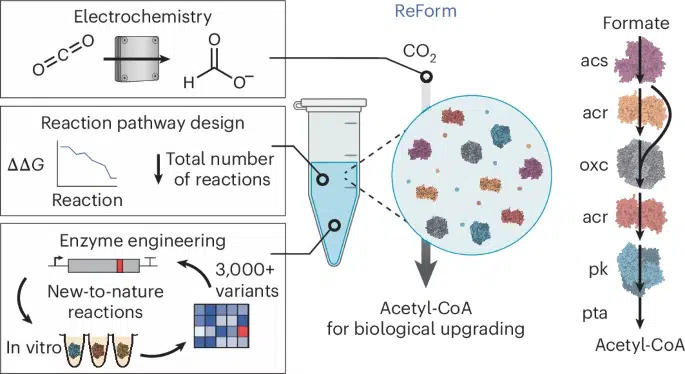
“ReForm can easily use various carbon sources, such as formate, formaldehyde, and methanol,” stated Jewett.
The integration of electrochemistry and synthetic biology allows for capturing CO₂ from the air and transforming it into green methanol.
Now, researchers aim to optimize the metabolic pathway to make carbon transformation more efficient.
These same tools could also develop other types of enzymes.
“We foresee that hybrid technologies integrating the best of chemistry and biology will provide new transformative directions for a carbon and energy-efficient future,” explained Jewett.
Therefore, Karim envisions multiple directions for this innovation. “It gives us hope for a future where we can combine multiple technologies, biological and abiological, in unique ways to find new solutions,” he concluded.



