



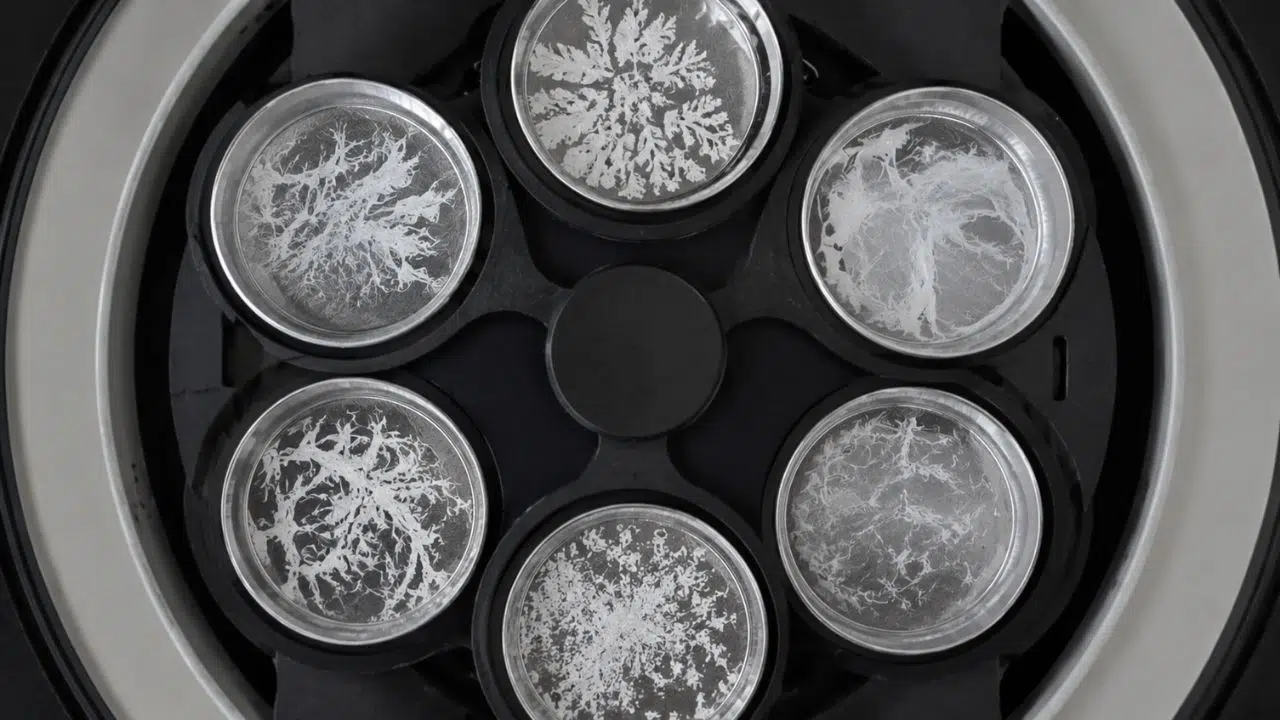
The lack of access to drinking water remains one of the most severe silent crises on the planet. Prolonged droughts, river pollution, and overexploitation of aquifers affect millions of people. In this context, researchers from Stanford University developed a hydrogel capable of capturing moisture from the air and transforming it into drinking water using only solar energy.
How the hydrogel works
- Composition: lithium chloride and an absorbent polymer similar to that used in hygiene products.
- Nocturnal process: captures atmospheric moisture.
- Daytime release: with the sun’s heat, the water evaporates, condenses, and is collected as liquid water suitable for consumption.
- Durability: exceeds 190 usage cycles, compared to 30 of previous hydrogels.
- Production: up to 2 liters daily, enough to cover basic hydration needs in emergencies.
Technological innovation
The key advancement was applying an anti-corrosion coating on the device’s metal surfaces. This prevented the release of ions that degraded the polymer, achieving stability even at extreme temperatures of 75 °C.
Application potential
This autonomous system does not require electricity, pipes, or nearby aquifers, opening possibilities in:
- Isolated rural communities.
- Climate shelters and temporary camps.
- Regions affected by natural disasters.
- Refugee camps and conflict zones.
Currently, many arid areas rely on tanker trucks that travel long distances consuming fossil fuels. An autonomous solar system could reduce that dependency and improve sustainability.
Economic and environmental impact
The team estimates that, if scaled industrially, the cost could approach 0.01 dollars per liter, much lower than bottled water and competitive compared to other decentralized systems. Additionally, the technology could help reduce the water pressure generated by industries such as data centers and semiconductor manufacturing, which consume large volumes of fresh water.
Pending challenges
- Improve efficiency and increase daily production.
- Reduce material costs for mass production.
- Evaluate its resistance to dust, ultraviolet radiation, and extreme climate variations.
Inspiration from nature
Other international projects explore similar solutions inspired by desert organisms, such as the Namibian beetles or cacti capable of condensing water from fog. The difference with Stanford’s hydrogel lies in its durability, low energy consumption, and mechanical simplicity.
Stanford’s solar hydrogel demonstrates that atmospheric water capture is no longer just a laboratory experiment: it is approaching practical applications with humanitarian and environmental potential. Producing drinking water directly from the air could become a key tool against droughts, heatwaves, and global water stress.



