



A new bioinspired battery could revolutionize energy storage thanks to a mechanism similar to the one blood uses to transport oxygen. The system, developed by researchers at the University of Wisconsin-Madison, uses a silicone oil-in-water emulsion that efficiently stores oxygen, increasing performance and reducing battery size.
This approach imitates the work of hemoglobin, allowing oxygen to diffuse within the liquid instead of relying on limited contact with air. Thus, a faster reaction and higher energy density are achieved, something crucial for mobile systems like robots, drones, or medical devices.
The advancement also addresses a growing need: to develop cleaner, lighter, and more efficient batteries. With this type of technology, the door opens to energy solutions that require fewer toxic materials and perform better in confined spaces.
The design combines sustainability, efficiency, and versatility, without the need for complex pressure mechanisms or high temperatures to operate.
Beyond Robots: Liquid Energy with Environmental Impact
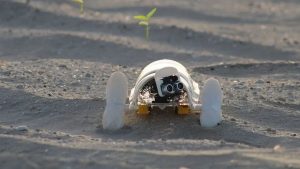
While conceived with the idea of extending the autonomy of robots, this liquid battery has the potential to redefine other ecological sectors. It can be integrated into systems that transform carbon dioxide into fuels, optimizing processes that previously required expensive or polluting technologies.
It is also envisioned as a solution for compact chemical laboratories, capable of operating in remote areas or with renewable energy sources. Its versatility makes it attractive for medical, submarine, or polar environments, where traditional energy systems easily fail.
Moreover, researchers are already working on completely replacing solid parts with liquid components. This would allow for a 100% fluid battery, simpler to manufacture, easier to scale, and with a longer life cycle, without the need for constant recharges.
Towards a Cleaner Energy Future
Biomimicry, or nature-inspired design, emerges as a strategic tool to advance towards more sustainable energy systems. This technology reduces the dependence on rare metals, simplifies maintenance, and optimizes the use of available resources.
Furthermore, it could reduce the pollution generated by the production and disposal of traditional batteries, especially those based on lithium or heavy metals. With fewer hazardous components, the environmental impact is also reduced.
These liquid batteries represent a crucial evolution towards more environmentally friendly energy models, capable of adapting to the technological challenges of the present without compromising the health of the planet.

Benefits of Biomimicry
Biomimicry harnesses solutions developed by nature over millions of years of evolution, adapting them to more efficient and sustainable human technologies. This approach allows for creating systems that optimize resources, consume less energy, and have a lower environmental impact.
In addition to fostering innovation, it reduces the dependency on toxic or scarce materials, promoting circular and self-regulating designs. Examples like antibacterial surfaces inspired by shark skin or buildings that regulate their temperature like termite mounds show its versatility.
By mimicking biological processes, biomimicry drives a more harmonious technological transition with the planet, paving the way towards a regenerative and resilient development in the face of challenges like climate change.


